Application
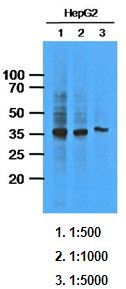
WB analysis of HepG2 lysate (33ug per lane) using AKR1C1 antibody at the indicated dilutions.| Product Name | AKR1C1 antibody |
|---|---|
| Antibody Type | Primary Antibodies |
| Product description | Mouse monoclonal antibody [AT6D10] to AKR1C1This gene encodes a member of the aldo/keto reductase superfamily, which consists of more than 40 known enzymes and proteins. These enzymes catalyze the conversion of aldehydes and ketones to their corresponding alcohols by utilizing NADH and/or NADPH as cofactors. The enzymes display overlapping but distinct substrate specificity. This enzyme catalyzes the reaction of progesterone to the inactive form 20-alpha-hydroxy-progesterone. This gene shares high sequence identity with three other gene members and is clustered with those three genes at chromosome 10p15-p14. [provided by RefSeq, Jul 2008] |
| Immunogen | Recombinant human AKR1C1 (1-323aa) purified from E. coli |
| Clonality | Monoclonal |
|---|---|
| Isotype | IgG1 |
| Clone Number | AT6D10 |
| Host Species | Mouse |
| Tested Applications | ELISAWB |
| The antibody has been tested by ELISA and Western blot analysis to assure specificity and reactivity. Since application varies, however, each investigation should be titrated by the reagent to obtain optimal results. Recommended dilution range for Western blot analysis is 1:1000. Recommended starting dilution is 1:1000: |
|
| Species Reactivity | Human |
| Concentration | 1mg/ml (Please refer to the vial label for the specific concentration) |
| Purification | Affinity purified |
| Gene Synonyms | C9 2-ALPHA-HSD DD1/DD2 DD1 aldo-keto reductase family 1 member C1 20-ALPHA-HSD MBAB DDH HBAB H-37 DDH1 HAKRC |
|---|---|
| Target | AKR1C1 |
| Light Chain Type | kappa |
Application
WB analysis of HepG2 lysate (33ug per lane) using AKR1C1 antibody at the indicated dilutions.| Application Notes | The antibody has been tested by ELISA and Western blot analysis to assure specificity and reactivity. Since application varies, however, each investigation should be titrated by the reagent to obtain optimal results. Recommended dilution range for Western blot analysis is 1:1000. Recommended starting dilution is 1:1000: |
|---|
| Form | Liquid |
|---|---|
| Storage Instructions | Can be stored at +4C. For long term storage, aliquot and store at -20C. Avoid repeated freezing and thawing cycles. |
| Storage Buffer | Phosphate-Buffered Saline (pH 7.4) with 0.1% Sodium Azide |


