Application
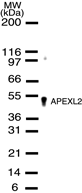
Western blot analysis of APEXL2 in HeLa cell lysates at a dilution of 1:500.| Product Name | APEX2 antibody |
|---|---|
| Antibody Type | Primary Antibodies |
| Product description | Rabbit polyclonal to APEX2Apurinic/apyrimidinic (AP) sites occur frequently in DNA molecules by spontaneous hydrolysis, by DNA damaging agents or by DNA glycosylases that remove specific abnormal bases. AP sites are pre-mutagenic lesions that can prevent normal DNA replication so the cell contains systems to identify and repair such sites. Class II AP endonucleases cleave the phosphodiester backbone 5' to the AP site. This gene encodes a protein shown to have a weak class II AP endonuclease activity. Most of the encoded protein is located in the nucleus but some is also present in mitochondria. This protein may play an important role in both nuclear and mitochondrial base excision repair (BER). |
| Immunogen | Synthetic peptides of human APEXL2 |
| Clonality | Polyclonal |
|---|---|
| Isotype | IgG |
| Host Species | Rabbit |
| Tested Applications | WB |
| WB: Use at a dilution of 1/500. Detects a band of approximately 54 kDa. Optimal dilutions/concentrations should be determined by the end user. | |
| Species Reactivity | Human |
| Concentration | 1mg/ml |
| Purification | Protein G |
| Gene Synonyms | XTH2, Q9UBZ4, 27301, APEX2, APEXL2, APE2 |
|---|---|
| Target | APEX2 |
| Cellular Localization | Nuclear |
Application
Western blot analysis of APEXL2 in HeLa cell lysates at a dilution of 1:500.| Application Notes | WB: Use at a dilution of 1/500. Detects a band of approximately 54 kDa. Optimal dilutions/concentrations should be determined by the end user. |
|---|
| Form | Liquid |
|---|---|
| Storage Instructions | Keep as concentrated solution. Store at 4ºC short term. For extended storage aliquot and store at -20ºC or below. Avoid freeze-thaw cycles. |
| Storage Buffer | Phosphate-buffered saline, pH 7.2, containing 0.02% Sodium Azide |


