Application
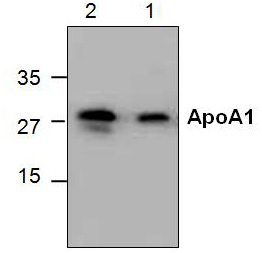
Western blot analysis of ApoA1 with recombinant rat ApoA1 Lane 1: 10 ng Lane: 50 ng| Product Name | Apolipoprotein A1 antibody |
|---|---|
| Antibody Type | Primary Antibodies |
| Product description | Rabbit polyclonal antibody to Apolipoprotein A1ApoA1 is a 29.0 kDa protein produced in the liver and intestine, and secreted as the predominant constituent of nascent high-density lipoprotein (HDL) particle. ApoA1 which is found exclusively in HDL has a unique ability to capture and solubilize free cholesterol. This ApoA-I ability enables HDL to remove excess peripheral cholesterol and return it to the liver for recycling and excretion. This process, called reverse cholesterol transport, is thought to inhibit atherogenesis. For this reason HDL is also known as the “good cholesterol.” The therapeutic potential of apoA-I has been recently assessed in patients with acute coronary syndromes, using a recombinant form of a naturally occurring variant of ApoA-I (called ApoA1 Milano). Rat ApoA1 s a 27.4 kDa protein of 235 amino acid residues. |
| Clonality | Polyclonal |
|---|---|
| Isotype | IgG |
| Host Species | Rabbit |
| Tested Applications | WB |
| Western blot analysis (0.5-4 µg/ml). Recombinant rat ApoA1 can be use as a positive control. However, the optimal conditions should be determined individually. Other applications have not been determined. | |
| Species Reactivity | Rat |
| Concentration | 0.5mg/ml |
| Purification | Affinity purified |
| Gene Synonyms | ApoA1, Apo-A1, Apolipoprotein A-1, ApoA-1, Apolipoprotein A1, Apo A1, ApoA 1, Apolipoprotein A 1 |
|---|---|
| Target | Apolipoprotein A1 |
| Tissue Specificity | This antibody is specific for ApoA1. |
Application
Western blot analysis of ApoA1 with recombinant rat ApoA1 Lane 1: 10 ng Lane: 50 ng| Application Notes | Western blot analysis (0.5-4 µg/ml). Recombinant rat ApoA1 can be use as a positive control. However, the optimal conditions should be determined individually. Other applications have not been determined. |
|---|
| Form | Liquid |
|---|---|
| Storage Instructions | The antibody solution should be gently mixed before use. Aliquot and store at -20ºC. Avoid multiple freeze-thaw cycles.Product should remain stable for at least 12 months. |
| Storage Buffer | PBS (pH 7.2) containing 30% glycerol and 0.01% thimerosal |


