Application
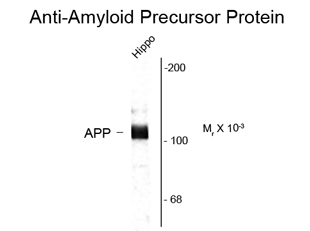
Western blot of rat hippocampal lysate showing specific immunolabeling of the ~115k APP protein using Amyloid Precursor Protein antibody .| Product Name | APP antibody |
|---|---|
| Antibody Type | Primary Antibodies |
| Product description | Rabbit polyclonal antibody to APPFunctions as a cell surface receptor and performs physiological functions on the surface of neurons relevant to neurite growth, neuronal adhesion and axonogenesis. Involved in cell mobility and transcription regulation through protein-protein interactions (By similarity). Can promote transcription activation through binding to APBB1-KAT5 and inhibit Notch signaling through interaction with Numb (By similarity). Couples to apoptosis-inducing pathways such as those mediated by G(O) and JIP. Inhibits G(o) alpha ATPase activity. Acts as a kinesin I membrane receptor, mediating the axonal transport of beta-secretase and presenilin 1 (By similarity). May be involved in copper homeostasis/oxidative stress through copper ion reduction. Can regulate neurite outgrowth through binding to components of the extracellular matrix such as heparin and collagen I and IV (By similarity). The splice isoforms that contain the BPTI domain possess protease inhibitor activity. Induces a AGER-dependent pathway that involves activation of p38 MAPK, resulting in internalization of amyloid-beta peptide and leading to mitochondrial dysfunction in cultured cortical neurons. Beta-amyloid peptides are lipophilic metal chelators with metal-reducing activity. Bind transient metals such as copper, zinc and iron. Rat and mouse beta-amyloid peptides bind only weakly transient metals and have little reducing activity due to substitutions of transient metal chelating residues. Beta-APP42 may activate mononuclear phagocytes in the brain and elicit inflammatory responses. Promotes both tau aggregation and TPK II-mediated phosphorylation. Appicans elicit adhesion of neural cells to the extracellular matrix and may regulate neurite outgrowth in the brain. The gamma-CTF peptides as well as the caspase-cleaved peptides, including C31, are potent enhancers of neuronal apoptosis. N-APP binds TNFRSF21 triggering caspase activation and degeneration of both neuronal cell bodies (via caspase-3) and axons (via caspase-6). |
| Immunogen | Synthetic peptide corresponding to amino acid residues from the C-terminal region conjugated to KLH |
| Clonality | Polyclonal |
|---|---|
| Isotype | IgG |
| Host Species | Rabbit |
| Tested Applications | WB |
| Optimal working dilutions should be determined experimentally by the end user. | |
| Species Reactivity | Rat |
| Concentration | 1mg/ml |
| Purification | Affinity purified |
| Gene Synonyms | APP, amyloid beta peptide, ABPP, Amyloid beta A4 protein, Cerebral vascular amyloid peptide, Alzheimer disease amyloid protein, APPI, amyloid-b-peptide, amyloidbpeptide, amyloid b peptide |
|---|---|
| Target | APP |
| Molecular Weight(MW) | 115 (note) |
| Cellular Localization | Cell surface protein that rapidly becomes internalized via clathrin-coated pits. During maturation, the immature APP (N-glycosylated in the endoplasmic reticulum) moves to the Golgi complex where complete maturation occurs (O-glycosylated and sulfated). A |
Application
Western blot of rat hippocampal lysate showing specific immunolabeling of the ~115k APP protein using Amyloid Precursor Protein antibody .| Application Notes | Optimal working dilutions should be determined experimentally by the end user. |
|---|
| Form | Liquid |
|---|---|
| Storage Instructions | For long-term storage, aliquot and store at -20 C. Avoid repeated freeze/thaw cycles. |
| Storage Buffer | 100 µl in 10 mM HEPES (pH 7.5), 150 mM NaCl, 100 µg per ml BSA and 50% glycerol. |


