Application
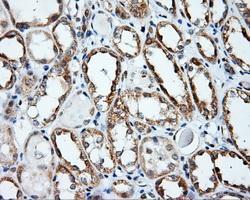
Immunohistochemical staining of paraffin-embedded Kidney tissue using anti-APP mouse monoclonal antibody. ( Dilution 1:50)Application
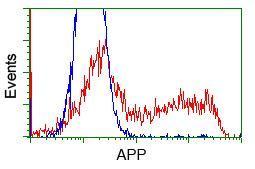
HEK293T cells transfected with either pCMV6-ENTRY APPApplication
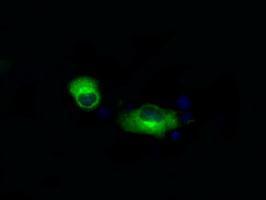
Anti-APP mouse monoclonal antibody immunofluorescent staining of COS7 cells transiently transfected with APPApplication
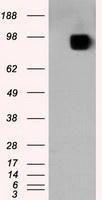
HEK293T cells were transfected with the pCMV6-ENTRY control (Left lane) or pCMV6-ENTRY APP (Right lane) cDNA for 48 hrs and lysed. Equivalent amounts of cell lysates (5 ug per lane) were separated by SDS-PAGE and immunoblotted with anti-APP.Application
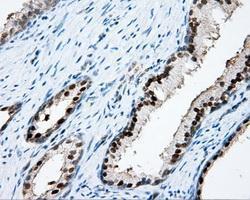
Immunohistochemical staining of paraffin-embedded prostate tissue using anti-APP mouse monoclonal antibody. ( Dilution 1:50)| Product Name | APP antibody [7B8] |
|---|---|
| Antibody Type | Primary Antibodies |
| Product description | Mouse monoclonal antibody [7B8] to APPFunctions as a cell surface receptor and performs physiological functions on the surface of neurons relevant to neurite growth, neuronal adhesion and axonogenesis. Involved in cell mobility and transcription regulation through protein-protein interactions. Can promote transcription activation through binding to APBB1-KAT5 and inhibits Notch signaling through interaction with Numb. Couples to apoptosis-inducing pathways such as those mediated by G(O) and JIP. Inhibits G(o) alpha ATPase activity (By similarity). Acts as a kinesin I membrane receptor, mediating the axonal transport of beta-secretase and presenilin 1. Involved in copper homeostasis/oxidative stress through copper ion reduction. In vitro, copper-metallated APP induces neuronal death directly or is potentiated through Cu(2+)-mediated low-density lipoprotein oxidation. Can regulate neurite outgrowth through binding to components of the extracellular matrix such as heparin and collagen I and IV. The splice isoforms that contain the BPTI domain possess protease inhibitor activity. Induces a AGER-dependent pathway that involves activation of p38 MAPK, resulting in internalization of amyloid-beta peptide and leading to mitochondrial dysfunction in cultured cortical neurons. Beta-amyloid peptides are lipophilic metal chelators with metal-reducing activity. Bind transient metals such as copper, zinc and iron. In vitro, can reduce Cu(2+) and Fe(3+) to Cu(+) and Fe(2+), respectively. Beta-amyloid 42 is a more effective reductant than beta-amyloid 40. Beta-amyloid peptides bind to lipoproteins and apolipoproteins E and J in the CSF and to HDL particles in plasma, inhibiting metal-catalyzed oxidation of lipoproteins. Beta-APP42 may activate mononuclear phagocytes in the brain and elicit inflammatory responses. Promotes both tau aggregation and TPK II-mediated phosphorylation. Interaction with overexpressed HADH2 leads to oxidative stress and neurotoxicity. Appicans elicit adhesion of neural cells to the extracellular matrix and may regulate neurite outgrowth in the brain. The gamma-CTF peptides as well as the caspase-cleaved peptides, including C31, are potent enhancers of neuronal apoptosis. N-APP binds TNFRSF21 triggering caspase activation and degeneration of both neuronal cell bodies (via caspase-3) and axons (via caspase-6). |
| Immunogen | Full length human recombinant protein of human APP (NP_000475) produced in HEK293T cell. |
| Clonality | Monoclonal |
|---|---|
| Isotype | IgG1 |
| Clone Number | 7B8 |
| Host Species | Mouse |
| Tested Applications | FACSICC/IFIHCIHC-PWB |
| IHC 1:50 | |
| Species Reactivity | Human |
| Concentration | 1mg/ml |
| Purification | Affinity purified |
| Gene Synonyms | APP, ABETA, CTFgamma, ABPP, AD1, APPI, CVAP, PN2, AAA |
|---|---|
| Target | APP |
| Tissue Specificity | is specific for human APP (NP_000475). |
Application
Immunohistochemical staining of paraffin-embedded Kidney tissue using anti-APP mouse monoclonal antibody. ( Dilution 1:50)
Application
HEK293T cells transfected with either pCMV6-ENTRY APP
Application
Anti-APP mouse monoclonal antibody immunofluorescent staining of COS7 cells transiently transfected with APP
Application
HEK293T cells were transfected with the pCMV6-ENTRY control (Left lane) or pCMV6-ENTRY APP (Right lane) cDNA for 48 hrs and lysed. Equivalent amounts of cell lysates (5 ug per lane) were separated by SDS-PAGE and immunoblotted with anti-APP.
Application
Immunohistochemical staining of paraffin-embedded prostate tissue using anti-APP mouse monoclonal antibody. ( Dilution 1:50)| Application Notes | IHC 1:50 |
|---|
| Form | Liquid |
|---|---|
| Storage Instructions | For short-term storage, store at 4°C or aliquot into working amounts and store at -20°C. For long-term storage, store at -70°C (aliquotted). Avoid repeated freeze-thaw cycles. |
| Storage Buffer | PBS (PH 7.3) containing 1% BSA, 50% glycerol and 0.02% sodium azide. |


