Application
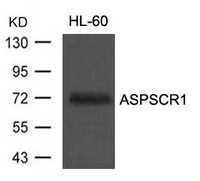
Western blot analysis of extracts from HL60 cells using ASPSCR1 Antibody .| Product Name | ASPSCR1 antibody |
|---|---|
| Antibody Type | Primary Antibodies |
| Product description | Rabbit Polyclonal antibody to ASPSCR1Tug (Tether containing UBX domain for GLUT4), also known as ASPL, ASPSCR1, RCC17, UBXD9, UBXN9, was first identified as a chromosomal translocation partner for TFE3 in patients with Alveolar soft part sarcoma and contains an UBX-like domain in its C-terminal region. Tug is found to tether GLUT4 in intracellular vesicles and to release GLUT4 for cell surface translocation upon insulin stimulation . Stable Tug depletion or expression of a dominant negative form stimulates GLUT4 redistribution. |
| Immunogen | Peptide sequence around aa.303 ~307(P-Q-Q-E-Q) derived from Human ASPSCR1. |
| Clonality | Polyclonal |
|---|---|
| Host Species | Rabbit |
| Tested Applications | WB |
| Suggested starting dilutions are as follows. WB: 1:500~1:1000. Not yet tested in other applications. Optimal working dilutions should be determined experimentally by the end user.: |
|
| Species Reactivity | Human |
| Concentration | 1mg/ml (Please refer to the vial label for the specific concentration) |
| Purification | Affinity purified |
| Gene Synonyms | ASPCR1 ASPL ASPS FLJ45380 RCC17 TUG UBXD9 UBXN9 ASPSCR1 alveolar soft part sarcoma locus UBX domain protein 9 renal cell carcinoma gene on chromosome 17 tether containing UBX domain for GLUT4 renal cell carcinoma papillary 17 alveolar soft |
|---|---|
| Target | ASPSCR1 |
| Molecular Weight(MW) | 70-75 (note) |
Application
Western blot analysis of extracts from HL60 cells using ASPSCR1 Antibody .| Application Notes | Suggested starting dilutions are as follows. WB: 1:500~1:1000. Not yet tested in other applications. Optimal working dilutions should be determined experimentally by the end user.: |
|---|
| Form | Liquid |
|---|---|
| Storage Instructions | Keep as concentrated solution. Aliquot and store at -20ºC or below. Avoid multiple freeze-thaw cycles. |
| Storage Buffer | saline (without Mg2+ and Ca2+), pH 7.4, 150mM NaCl, 0.02% sodium azide and 50% glycerol. |


