Application
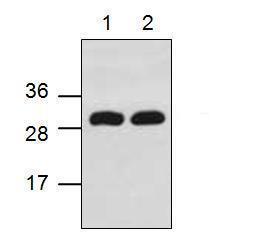
Western blot analysis of APG16/ATG16 in Jurkat cell lysates(Lane 1&2)| Product Name | ATG16L1 antibody |
|---|---|
| Antibody Type | Primary Antibodies |
| Product description | Rabbit polyclonal antibody to ATG16L1Autophagy, the process of bulk degradation of cellular proteins through an autophagosomic-lysosomal pathway is important for normal growth control and may be defective in tumor cells. It is involved in the preservation of cellular nutrients under starvation conditions as well as the normal turnover of cytosolic components. This process is negatively regulated by TOR (Target of rapamycin) through phosphorylation of autophagy protein APG1. ATG16, another member of the autophagy protein family, forms a complex with the ATG5-ATG12 conjugate. This multimeric protein has been shown to be essential for autophagosome formation in both yeast and mammals and targets the ATG5-ATG12 complex to the autophagic isolation membrane during the formation of the autophagosome. Because mammalian ATG16 has seven WD-repeats in its C-terminal domain, it has been suggested that these may form a platform for further protein-protein interactions. Multiple isoforms of ATG16 are known to exist. |
| Clonality | Polyclonal |
|---|---|
| Isotype | IgG |
| Host Species | Rabbit |
| Tested Applications | WB |
| Western blotting (0.5-4 µg/ml). However, the optimal conditions should be determined individually. Other applications have not been determined.: |
|
| Species Reactivity | HumanMouseRat |
| Concentration | 0.5mg/ml |
| Purification | Affinity purified |
| Gene Synonyms | APG16 ATG16L1 APTG 16 APTG16 |
|---|---|
| Target | ATG16L1 |
| Tissue Specificity | This antibody is specific for APG16/ATG16. |
| Cellular Localization | Localized to preautophagosomal structure (PAS) where it is involved in the membrane targeting of ATG5. |
Application
Western blot analysis of APG16/ATG16 in Jurkat cell lysates(Lane 1&2)| Application Notes | Western blotting (0.5-4 µg/ml). However, the optimal conditions should be determined individually. Other applications have not been determined.: |
|---|
| Form | Liquid |
|---|---|
| Storage Instructions | The antibody solution should be gently mixed before use. Stored at -20 °C for future use. |
| Storage Buffer | PBS (pH 7.2) containing 30% glycerol, 0.5 mg/ml BSA and 0.01% thimerosal |


