Application
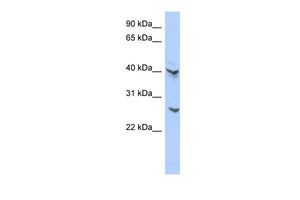
WB analysis of COLO205 cells using ATP6V0E2 antibody at 0.2-1μg/ml.| Product Name | ATP6V0E2 antibody, Internal |
|---|---|
| Antibody Type | Primary Antibodies |
| Product description | Rabbit Polyclonal antibody to ATP6V0E2Multisubunit vacuolar-type proton pumps, or H(+)-ATPases, acidify various intracellular compartments, such as vacuoles, clathrin-coated and synaptic vesicles, endosomes, lysosomes, and chromaffin granules. H(+)-ATPases are also found in plasma membranes of specialized cells, where they play roles in urinary acidification, bone resorption, and sperm maturation. Multiple subunits form H(+)-ATPases, with proteins of the V1 class hydrolyzing ATP for energy to transport H+, and proteins of the V0 class forming an integral membrane domain through which H+ is transported. ATP6V0E2 encodes an isoform of the H(+)-ATPase V0 e subunit, an essential proton pump component (Blake-Palmer et al., 2007 [PubMed 17350184]).[supplied by OMIM, Mar 2008] |
| Immunogen | A synthetic peptide corresponding to an Internal region of Human ATP6V0E2 |
| Clonality | Polyclonal |
|---|---|
| Isotype | IgG |
| Host Species | Rabbit |
| Tested Applications | WB |
| *Optimal dilutions/concentrations should be determined by the researcher.
: |
|
| Species Reactivity | Human |
| Predicted Reactivity | Human: 100% |
| Concentration | 1mg/ml |
| Purification | Affinity purified |
| Gene Synonyms | ATP6V0E2L C7ORF32 ATP6V0E2 |
|---|---|
| Target | ATP6V0E2 |
| Molecular Weight(MW) | 9 KDa (note) |
Application
WB analysis of COLO205 cells using ATP6V0E2 antibody at 0.2-1μg/ml.| Positive Control | COLO205 |
|---|---|
| Application Notes | *Optimal dilutions/concentrations should be determined by the researcher.
: |
| Form | Liquid |
|---|---|
| Storage Instructions | Keep as concentrated solution. For short-term storage, store at 4ºC. For long-term storage, aliquot and store at -20ºC or below. Avoid multiple freeze-thaw cycles. |
| Storage Buffer | 1x PBS buffer with 0.09% (w/v) sodium azide and 2% sucrose. |


