Application
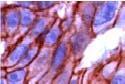
Breast carcinoma stained withApplication
Human Breast Carcinoma stained with anti-Catenin-beta antibody| Product Name | beta Catenin antibody (ready-to-use) |
|---|---|
| Antibody Type | Primary Antibodies |
| Product description | Rabbit polyclonal antibody to beta CateninThe distinct peripheral cytosolic proteins, alpha, beta and gamma-catenin (102, 94 and 86 kD) found in many tissues bind to the conserved cytoplasmic tail domain of the cell-adhesion cadherins. Catenins link E-cadherin to other integral membrane or cytoplasmic proteins and are modulated by Wnt-1 proto-oncogene. They are good candidates for mediating transduction of cell-cell contact positional signals to the cell interior. Absence of alpha-catenin is found in certain tumor cell lines and reduced levels in certain human carcinomas. Beta-catenin binds directly to the cytoplasmic tail of E-cadherin. It binds to the N-terminus of alpha-catenin and interacts with the protein product of the tumor suppressor gene APC. This interaction involves a 15-aa repeat in the APC. Beta-catenin cell levels seem to be controlled by APC. The central core region of beta-catenin is involved in mediation of cadherin-catenin complex interaction with EGFR. |
| Immunogen | Synthetic peptide (C terminal) |
| Clonality | Polyclonal |
|---|---|
| Isotype | IgG |
| Host Species | Rabbit |
| Tested Applications | IHCIHC-P |
| Staining of formalin-fixed tissues requires boiling tissue sections in 10mM citrate buffer, pH 6.0 for 10 min followed by cooling at RT for 20 min. Optimal dilutions/concentrations should be determined by the end user. | |
| Species Reactivity | HumanMouseRat |
| Concentration | 1mg/ml |
| Purification | Affinity purified |
| Gene Synonyms | CTNNB1, P35222, 114550, 1499, beta Catenin, CTNNB, DKFZp686D02253, FLJ25606, FLJ37923 |
|---|---|
| Target | beta Catenin |
| Cellular Localization | Cytoplasmic/Cell membrane |
Application
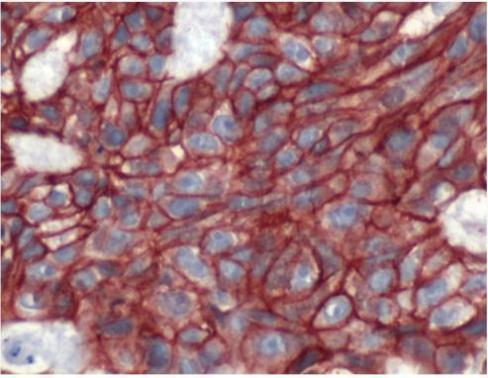
Breast carcinoma stained with
Application
Human Breast Carcinoma stained with anti-Catenin-beta antibody| Positive Control | Breast carcinoma |
|---|---|
| Application Notes | Staining of formalin-fixed tissues requires boiling tissue sections in 10mM citrate buffer, pH 6.0 for 10 min followed by cooling at RT for 20 min. Optimal dilutions/concentrations should be determined by the end user. |
| Form | Liquid |
|---|---|
| Storage Instructions | Keep as concentrated solution and store at 4°C. Do not freeze. |
| Storage Buffer | 1% BSA in pH 7.6 TBS buffer with less than 0.1% sodium azide |


