Application
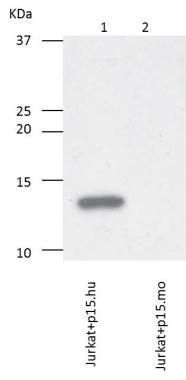
Western Blot Extracts of Jurkat cells with caspase-8 cleaved recombinant human BID (lane 1), or with caspase-8 cleaved recombinant mouse BID (lane 2) were resolved by SDS-PAGE on a 4-20% Tris-glycine gel and transferred to PVDF. The membrane was blocked with a 5% BSA-TBST buffer for one hour at room temperature, then incubated with Bid (p15-specific ) antibody for two hours at room temperature in a 1% BSA-TBST buffer. The data show that the human BID (p15) antibody recognizes only the human 15 kDa BID fragment, demonstrating the specificity of the antibody.Application
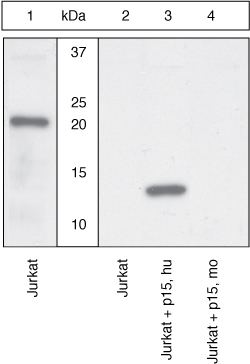
Extracts of Jurkat cells without added BID (lanes 1 and 2), with caspase-8 cleaved recombinant human BID (lane 3), or with caspase-8 cleaved recombinant mouse BID (lane 4) were resolved by SDS-PAGE on a 4-20% Tris-glycine gel and transferred to PVDF. The membrane was blocked with a 5% BSA-TBST buffer for one hour at room temperature, then incubated with either a human BID full length antibody (lane 1) or the human BID (p15) cleavage site-specific antibody (lanes 2-4) for two hours at room temperature in a 1% BSA-TBST buffer. After washing, the membrane was incubated with goat F(ab)2 anti-rabbit IgG alkaline phosphatase and signals were detected. The data show that the human BID (p15) antibody recognizes only the human 15 kDa BID fragment, demonstrating the specificity of the antibody.| Product Name | Bid (p15-specific ) antibody |
|---|---|
| Antibody Type | Primary Antibodies |
| Product description | Rabbit polyclonal to Bid (p15-specific ) antibodyBH3 interacting domain death agonist (BID) is a pro-apoptotic member of the Bcl 2 family. BID interacts with both Bcl 2 and Bax through its BH3 domain. It usually exists in an inactive form in the cytosolic fraction of living cells and becomes cleaved and activated by caspase 8 in response to TNF alpha or Fas ligand. Once BID is cleaved, the C-terminal 15 kDa fragment of BID (p15) translocates onto mitochondria and is sufficient to trigger cytochrome c release, resulting in cell apoptosis. BID serves as a direct molecular link between caspase 8 activation and mitochondrial death machinery. |
| Immunogen | Synthesis peptide corresponding to a region within amino acids 40 and 80 of human BID (p15). |
| Clonality | Polyclonal |
|---|---|
| Isotype | IgG |
| Host Species | Rabbit |
| Tested Applications | WB |
| WB: Use at a concentration of 0.25 - 1 μg/ml. Detects a band of approximately 15 kDa. Optimal dilutions/concentrations should be determined by the end user. | |
| Species Reactivity | Human |
| Concentration | 1mg/ml |
| Purification | Affinity purified |
| Gene Synonyms | Bid, 637, MGC42355, 601997, P55957, MGC15319,Bid (p15-specific ) antibody |
|---|---|
| Target | Bid (p15-specific ) |
| Tissue Specificity | Recognizes the human C-terminal 15 kDa fragment of BID (p15). |
| Cellular Localization | Cytoplasmic and Mitochondrial |
Application
Western Blot Extracts of Jurkat cells with caspase-8 cleaved recombinant human BID (lane 1), or with caspase-8 cleaved recombinant mouse BID (lane 2) were resolved by SDS-PAGE on a 4-20% Tris-glycine gel and transferred to PVDF. The membrane was blocked with a 5% BSA-TBST buffer for one hour at room temperature, then incubated with Bid (p15-specific ) antibody for two hours at room temperature in a 1% BSA-TBST buffer. The data show that the human BID (p15) antibody recognizes only the human 15 kDa BID fragment, demonstrating the specificity of the antibody.
Application
Extracts of Jurkat cells without added BID (lanes 1 and 2), with caspase-8 cleaved recombinant human BID (lane 3), or with caspase-8 cleaved recombinant mouse BID (lane 4) were resolved by SDS-PAGE on a 4-20% Tris-glycine gel and transferred to PVDF. The membrane was blocked with a 5% BSA-TBST buffer for one hour at room temperature, then incubated with either a human BID full length antibody (lane 1) or the human BID (p15) cleavage site-specific antibody (lanes 2-4) for two hours at room temperature in a 1% BSA-TBST buffer. After washing, the membrane was incubated with goat F(ab)2 anti-rabbit IgG alkaline phosphatase and signals were detected. The data show that the human BID (p15) antibody recognizes only the human 15 kDa BID fragment, demonstrating the specificity of the antibody.| Positive Control | Jurkat cells treated with anti Fas antibody to induce cleavage |
|---|---|
| Application Notes | WB: Use at a concentration of 0.25 - 1 μg/ml. Detects a band of approximately 15 kDa. Optimal dilutions/concentrations should be determined by the end user. |
| Form | Liquid |
|---|---|
| Storage Instructions | -20°C |
| Storage Buffer | PBS (without Mg2+ and Ca2+), pH 7.3, 50% glycerol with 1.0 mg/mL BSA, 0.05% sodium azide. |


