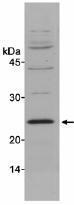
Application
at 1 mcg/ml staining mouse BID from mouse embryonic fibroblasts by Western blot ECL.| Product Name | Bid antibody |
|---|---|
| Antibody Type | Primary Antibodies |
| Product description | Rabbit polyclonal [BL1079] to BidBid, a BH3 domain containing proapoptotic Bcl2 family member, is localized in the cytosolic fraction of cells as an inactive precursor. Its active form is generated upon proteolytic cleavage by caspase 8 in the Fas signaling pathway. Cleaved Bid translocates to mitochondria and releases its potent proapoptotic activity, which in turn induces cytochrome c release and mitochondrial damage. The cytochrome c releasing activity of Bid was antagonized by Bcl2. Mutation in the SH3 domain can diminish the cytochrome c releasing activity. In animal model studies, Bid deficient mice are found resistant to the lethal effects of death factor signals relayed through Fas. |
| Immunogen | Synthetic peptide (Unfortunately the amino acid sequence is considered to be commercially sensitive). The peptide sequence is within the region between aa1 and aa50 of mouse BH3 using the numbering given in entry NP_031570.2 (GeneID 12122). |
| Clonality | Polyclonal |
|---|---|
| Isotype | IgG |
| Host Species | Rabbit |
| Tested Applications | WB |
| WB: Use at a dilution of 1/1000 - 1/10000. Predicted molecular weight: 23 kDa. Optimal dilutions/concentrations should be determined by the end user. Prepare working dilution immediately before use. | |
| Species Reactivity | HumanMouse |
| Concentration | 1mg/ml (Please refer to the vial label for the specific concentration) |
| Purification | Affinity purified |
| Gene Synonyms | FP497, MGC15319, MGC42355 |
|---|---|
| Target | Bid |
| Cellular Localization | Cytoplasmic |
Application
at 1 mcg/ml staining mouse BID from mouse embryonic fibroblasts by Western blot ECL.| Positive Control | Whole cell lysate from mouse embryonic fibroblast (MEF) cells. |
|---|---|
| Application Notes | WB: Use at a dilution of 1/1000 - 1/10000. Predicted molecular weight: 23 kDa. Optimal dilutions/concentrations should be determined by the end user. Prepare working dilution immediately before use. |
| Form | Liquid |
|---|---|
| Storage Instructions | Keep as concentrated solution. Store at 4ºC short term. For extended storage aliquot and store at -20ºC or below. Avoid freeze-thaw cycles. |
| Storage Buffer | Preservative: 0.1% Sodium Azide; Constituents: Tris-citrate/phosphate. pH 7-8. |


