Application
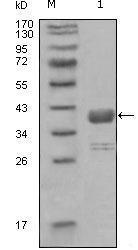
Western blot analysis using anti-ABL1 monoclonal antibody against truncated GST-ABL1 recombinant protein(1).| Product Name | c-Abl antibody |
|---|---|
| Antibody Type | Primary Antibodies |
| Product description | Mouse monoclonal antibody [7B11D6] to c-AblThe ABL1 protooncogene encodes a cytoplasmic and nuclear protein tyrosine kinase that has been implicated in processes of cell differentiation, cell division, cell adhesion, and stress response. Activity of c-Abl protein is negatively regulated by its SH3 domain, and deletion of the SH3 domain turns ABL1 into an oncogene. The t(9;22) translocation results in the head-to-tail fusion of the BCR (MIM:151410) and ABL1 genes present in many cases of chronic myelogeneous leukemia. The DNA-binding activity of the ubiquitously expressed ABL1 tyrosine kinase is regulated by CDC2-mediated phosphorylation, suggesting a cell cycle function for ABL1. The ABL1 gene is expressed as either a 6- or 7-kb mRNA transcript, with alternatively spliced first exons spliced to the common exons 2-11. [provided by RefSeq, Jul 2008] |
| Immunogen | The immunogen corresponding to a region within amino acids 577 and 650 of c-Abl expressed in E. Coli. |
| Clonality | Monoclonal |
|---|---|
| Isotype | IgG1 |
| Clone Number | 7B11D6 |
| Host Species | Mouse |
| Tested Applications | ELISAWB |
| ELISA: 1/10000.: |
|
| Species Reactivity | Human |
| Concentration | 1mg/ml |
| Gene Synonyms | V-ABL BCR/ABL P150 C-ABL ABL JTK7 |
|---|---|
| Target | c-Abl |
| Cellular Localization | Sequestered into the cytoplasm through interaction with 14-3-3 proteins. The myristoylated c-ABL protein is reported to be nuclear. |
Application
Western blot analysis using anti-ABL1 monoclonal antibody against truncated GST-ABL1 recombinant protein(1).| Application Notes | ELISA: 1/10000.: |
|---|
| Form | Liquid |
|---|---|
| Storage Instructions | Store at 4℃, for long term storage, store at -20℃. |
| Storage Buffer | Ascitic fluid containing 0.03% sodium azide. |


