Application
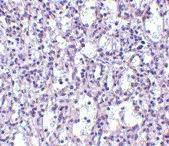
Immunohistochemistry of Carabin in human spleen tissue with Carabin antibody at 2.5 ug/ml.Application
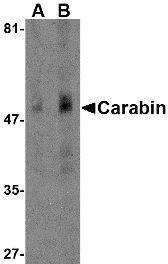
Western blot analysis of Carabin in human spleen tissue lysate with Carabin antibody at (A) 1 and (B) 2 ug/ml.| Product Name | Carabin antibody |
|---|---|
| Antibody Type | Primary Antibodies |
| Product description | Rabbit polyclonal antibody to CarabinAntigen binding by the T-cell receptor (TCR) is one of the critical first steps in the immune response, triggering a cascade of signaling pathways that ultimately lead to T-cell activation. Screening a yeast two-hybrid screen of a human T-cell cDNA library with calcineurin, a protein phosphatase involved in multiple signaling pathways including T-cell activation, resulted in the identification of Carabin, a member of the TBC1 domain family of proteins, as a calcineurin-binding protein. Unlike other members of the TBC1 domain protein family which are thought to have a role in regulating cell growth and differentiation, further experiments demonstrated that Carabin is part of a negative regulatory loop for the intracellular TCR signaling pathway as well as an inhibitor of the Ras signaling pathway, suggesting that Carabin may also mediate crosstalk between calcineurin and Ras. Carabin antibody does not recognize TBC1D10A or TBC1D10B. Carabin is known to exist in multiple isoforms. |
| Clonality | Polyclonal |
|---|---|
| Host Species | Rabbit |
| Tested Applications | ELISAIHC-PWB |
| IHC-P:1:50~1:200 WB:1:500~1:2000 Notes:Optimal dilutions/concentrations should be determined by the researcher. |
|
| Species Reactivity | HumanMouse |
| Concentration | 1mg/ml |
| Purification | Affinity purified |
| Gene Synonyms | TBC1 domain family member 10C TBC1D10C Carabin TBC1 domain family member10C |
|---|---|
| Target | Carabin |
| Tissue Specificity | This antibody is specific for Carabin |
Application
Immunohistochemistry of Carabin in human spleen tissue with Carabin antibody at 2.5 ug/ml.
Application
Western blot analysis of Carabin in human spleen tissue lysate with Carabin antibody at (A) 1 and (B) 2 ug/ml.| Positive Control | Blocking Peptide: Cat.No. GTX85049-PEP - Carabin Peptide Lysates: Cat. No. GTX27921 - Human Spleen Tissue Lysate |
|---|---|
| Application Notes | IHC-P:1:50~1:200 WB:1:500~1:2000 Notes:Optimal dilutions/concentrations should be determined by the researcher. |
| Form | Liquid |
|---|---|
| Storage Instructions | Keep as concentrated solution. Aliquot and store at -20ºC or below. Avoid multiple freeze-thaw cycles. |
| Storage Buffer | Antibody is supplied in PBS containing 0.02% sodium azide |


