Application
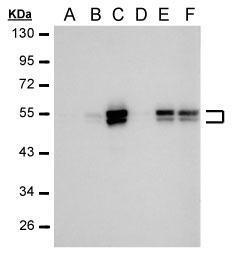
Sample (30 µg HeLa whole cell lysate) A: 24 hr Untreated B: 24 hr treatment with 100µM CoCl 2 C: 24 hr treatment with 200µM CoCl 2 D: 48 hr Untreated E: 48 hr treatment with 100µM CoCl 2 F: 48 hr treatment with 200µM CoCl 2 Anti-CAIX antibody [GT12] was used at a dilution of 1:1000 The HRP-conjugated anti-mouse IgG antibody was used to detect the primary antibody.Application
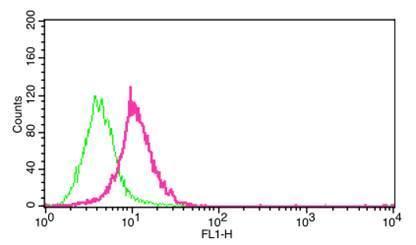
Flow cytometry on HeLa cells (1x10^6) stained with anti-CAIX antibody [GT12] at a 1:1000 dilution. HeLa cells were untreated (green) or treated with 200μM CoCl2 (pink) for 48 hr.Application
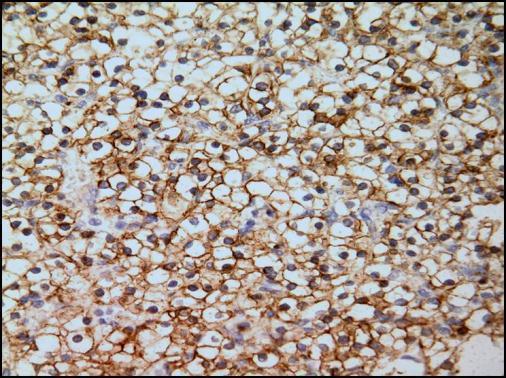
Immunohistochemical analysis of paraffin-embedded renal cell carcinoma (clear cell type) using anti-CAIX antibody [GT12] at a dilution of 1:1000.Application
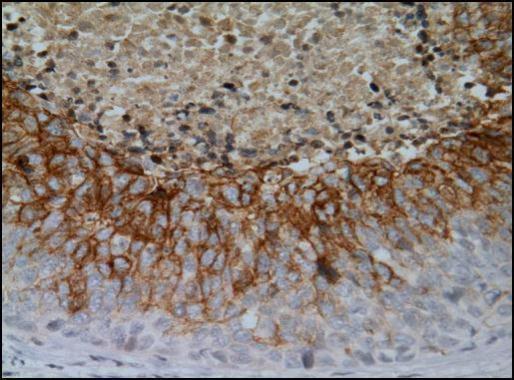
Immunohistochemical analysis of paraffin-embedded cervical CA tissue sections using anti-CAIX antibody [GT12] at a dilution of 1:1000. The hypoxic regions of the tumor show positive CAIX staining.Application
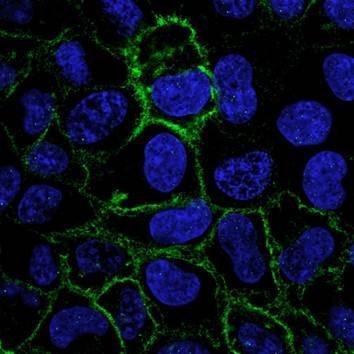
Confocal immunofluorescence analysis (Olympus FV10i) of methanol-fixed A431 cells treated with 200μM CoCl 2 for 48hr using anti-CAIX antibody [GT12] at a dilution of 1:1000.| Product Name | Carbonic Anhydrase IX antibody |
|---|---|
| Antibody Type | Primary Antibodies |
| Product description | Mouse monocloncal antibody [GT12] to Carbonic Anhydrase IXCarbonic anhydrase IX (CA IX) is a member of the CA family of zinc-binding enzymes that catalyze a reversible conversion between carbon dioxide and carbonic acid, in a reaction that involves facilitated hydration of CO2 to H2CO3 followed by the spontaneous dissociation of H2CO3 into bicarbonate and proton. The CA IX molecule consists of a large extracellular domain (ECD), single-pass transmembrane region (TM) and a short intracytoplasmic (IC) tail. The ECD contains an N-terminally located PG-like region (which is absent from the other carbonic anhydrase isoforms) and a centrally located, well conserved catalytic domain (CA). CA IX is a cell surface protein that is present in human tumors, but not in the corresponding normal tissues. Moreover, expression of CA IX correlates with poor prognosis in many tumor types. CA IX plays a role in two phenomena involved in development of tumor phenotype - control of cell adhesion and pH regulation. Tight association of CA IX with tumors is to a major part related to tumor hypoxia. |
| Clonality | Monoclonal |
|---|---|
| Isotype | IgG2 |
| Clone Number | GT12 |
| Host Species | Mouse |
| Tested Applications | FACSICC/IFIHCIHC-FIHC-PIPWB |
| For ICC/IF: Use at a dilution of 1:100-1:1000. For WB: Use at a dilution of 1:100-1:1000. For IHC-P: Use at a dilution of 1:100-1:1000. For FACS: Use at a dilution of 1:100-1:1000 for 1x10^6 cells. For IP: Use at a concentration of 2-10µg/mg lysate. Optimal dilutions/concentrations should be determined by the researcher.: |
|
| Species Reactivity | Human |
| Concentration | 1mg/ml |
| Gene Synonyms | Carbonic anhydrase9 carbonic anhydrase IX CA9 CA IX CAIX MN CA 9 G250 antigen CA-IX P54/58N RCC-associated antigen G250 RCC-associated protein G250 carbonate dehydratase IX carbonic anhydrase 9 carbonic dehydratase membrane antigen MN pMW1 |
|---|---|
| Target | Carbonic Anhydrase IX |
| Tissue Specificity | Clone GT12 binds to linear repetitive epitope in the PG region and allows for selective detection of both native and denatured CA IX without cross-reactivity to other carbonic anhydrases. |
Application
Sample (30 µg HeLa whole cell lysate) A: 24 hr Untreated B: 24 hr treatment with 100µM CoCl 2 C: 24 hr treatment with 200µM CoCl 2 D: 48 hr Untreated E: 48 hr treatment with 100µM CoCl 2 F: 48 hr treatment with 200µM CoCl 2 Anti-CAIX antibody [GT12] was used at a dilution of 1:1000 The HRP-conjugated anti-mouse IgG antibody was used to detect the primary antibody.
Application
Flow cytometry on HeLa cells (1x10^6) stained with anti-CAIX antibody [GT12] at a 1:1000 dilution. HeLa cells were untreated (green) or treated with 200μM CoCl2 (pink) for 48 hr.
Application
Immunohistochemical analysis of paraffin-embedded renal cell carcinoma (clear cell type) using anti-CAIX antibody [GT12] at a dilution of 1:1000.
Application
Immunohistochemical analysis of paraffin-embedded cervical CA tissue sections using anti-CAIX antibody [GT12] at a dilution of 1:1000. The hypoxic regions of the tumor show positive CAIX staining.
Application
Confocal immunofluorescence analysis (Olympus FV10i) of methanol-fixed A431 cells treated with 200μM CoCl 2 for 48hr using anti-CAIX antibody [GT12] at a dilution of 1:1000.| Application Notes | For ICC/IF: Use at a dilution of 1:100-1:1000. For WB: Use at a dilution of 1:100-1:1000. For IHC-P: Use at a dilution of 1:100-1:1000. For FACS: Use at a dilution of 1:100-1:1000 for 1x10^6 cells. For IP: Use at a concentration of 2-10µg/mg lysate. Optimal dilutions/concentrations should be determined by the researcher.: |
|---|
| Form | Liquid |
|---|---|
| Storage Instructions | Keep as concentrated solution. Aliquot and store at -20ºC or below. Avoid multiple freeze-thaw cycles. |
| Storage Buffer | PBS |


