Application
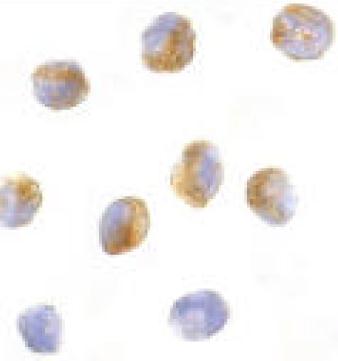
Immunocytochemical staining of CARD9 in K562 cells with CARD9 antibody at 10μg/ml.Application
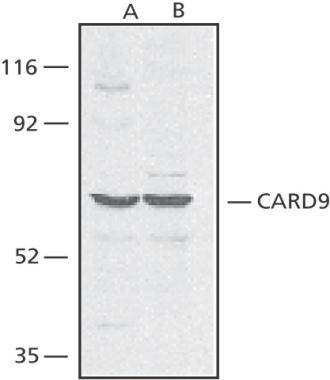
Western blot analysis of CARD9 expression in human MDA-MB-361 (A) and PC-3 (B) cell lysate with Anti-CARD9 (Cat. No. ) at 2.5 μg/mL.| Product Name | CARD 9 antibody |
|---|---|
| Antibody Type | Primary Antibodies |
| Product description | Rabbit polyclonal to CARD 9Apoptosis is related to many diseases and development. Cell death signals are transduced by death domain (DD), death effector domain (DED), and caspase recruitment domain (CARD) containing molecules. CARD containing proteins include some caspases, Apaf-1, CARD4, IAPs, RICK, ARC, RAIDD, BCL-10, and ASC. A novel CARD-containing protein was recently identified and designated CARD9, which interacts with the CARD activation domain of BCL-10 (1). CARD9 associates with BCL-10 and forms a complex within cells. CARD9 induces apoptosis and activates NF-kB. CARD9 is an upstream activator of BCL-10 and NF-kB signaling. |
| Immunogen | Synthetic peptide (DRENTTGSDNTDTEGS) corresponding to amino acids 521 to 536 of human CARD9 (1). The sequence is different from that of rat origin by two amino acids (1). |
| Clonality | Polyclonal |
|---|---|
| Isotype | IgG |
| Host Species | Rabbit |
| Tested Applications | ICC/IFWB |
| For WB: Use at a concentration of 0.5-1.0 μg/ml. A 59 kD band is detected. Optimal dilutions/concentrations should be determined by the researcher.: |
|
| Species Reactivity | Human |
| Concentration | 1mg/ml |
| Purification | Affinity purified |
| Gene Synonyms | 64170 hCARD9 607212 Q9H257 CARD9 CARD 9 |
|---|---|
| Target | CARD 9 |
Application
Immunocytochemical staining of CARD9 in K562 cells with CARD9 antibody at 10μg/ml.
Application
Western blot analysis of CARD9 expression in human MDA-MB-361 (A) and PC-3 (B) cell lysate with Anti-CARD9 (Cat. No. ) at 2.5 μg/mL.| Positive Control | PC-3 cell lysate |
|---|---|
| Application Notes | For WB: Use at a concentration of 0.5-1.0 μg/ml. A 59 kD band is detected. Optimal dilutions/concentrations should be determined by the researcher.: |
| Form | Liquid |
|---|---|
| Storage Instructions | Upon receipt - Keep as concentrated solution. Aliquot and store at -20ºC or below. Avoid freeze-thaw cycles. |
| Storage Buffer | Phosphate-buffered saline, pH 7.4, containing 0.02% sodium azide |


