Application
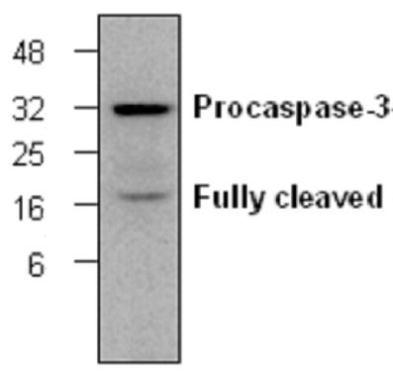
Western blot analysis of caspase-3 expression in HeLa cells treated with camptothecin (2 μM).| Product Name | Caspase 3 antibody |
|---|---|
| Antibody Type | Primary Antibodies |
| Product description | Mouse monoclonal antibody [C33] to Caspase 3The caspase family of cysteine proteases play a key role in apoptosis. Caspase-3 is the most extensively studied apoptotic protein among caspase family members. Caspase-3 is synthesized as inactive pro-enzyme that is processed in cells undergoing apoptosis by self-proteolysis and/or cleavage by another upstream protease. The processed form of caspase-3 consists of large (17 kD) and small (12 kD) subunits which associate to form an active enzyme. The active caspase-3 proteolytically cleaves and activates other caspases, as well as relevant targets in the cells (e.g., PARP and DFF). |
| Clonality | Monoclonal |
|---|---|
| Isotype | IgG1 |
| Clone Number | C33 |
| Host Species | Mouse |
| Tested Applications | WB |
| Western blotting (0.5-4 µg/ml). The antibody recognizes both proform and the cleaved large fragment of caspase-3 in samples of human, mouse and rat origins. However, the optimal conditions should be determined individually.: |
|
| Species Reactivity | HumanMouseRat |
| Concentration | 0.2mg/ml |
| Purification | Affinity purified |
| Gene Synonyms | apopain procaspase3 CASP3 CPP-32 SCA1 Yama CPP32B SCA-1 CPP32 Caspase3 SCA 1 CPP 32 |
|---|---|
| Target | Caspase-3 |
| Tissue Specificity | This antibody is specific for Caspase-3. |
Application
Western blot analysis of caspase-3 expression in HeLa cells treated with camptothecin (2 μM).| Application Notes | Western blotting (0.5-4 µg/ml). The antibody recognizes both proform and the cleaved large fragment of caspase-3 in samples of human, mouse and rat origins. However, the optimal conditions should be determined individually.: |
|---|
| Form | Liquid |
|---|---|
| Storage Instructions | The antibody solution should be gently mixed before use. Store at +4C. Product should remain stable for at least 12 months. |
| Storage Buffer | PBS containing 50% glycerol, 0.5 mg/ml BSA and 0.01% thimerosal. |


