Application
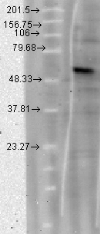
Western blot analysis of CavBeta4 in T-CHO lysates using a 1:1000 dilution of| Product Name | Cav beta 4 antibody |
|---|---|
| Antibody Type | Primary Antibodies |
| Product description | Mouse Monoclonal antibody [S10-7] to Cav beta 4This gene encodes a member of the beta subunit family of voltage-dependent calcium channel complex proteins. Calcium channels mediate the influx of calcium ions into the cell upon membrane polarization and consist of a complex of alpha-1, alpha-2/delta, beta, and gamma subunits in a 1:1:1:1 ratio. Various versions of each of these subunits exist, either expressed from similar genes or the result of alternative splicing. The protein encoded by this locus plays an important role in calcium channel function by modulating G protein inhibition, increasing peak calcium current, controlling the alpha-1 subunit membrane targeting and shifting the voltage dependence of activation and inactivation. Certain mutations in this gene have been associated with idiopathic generalized epilepsy (IGE) and juvenile myoclonic epilepsy (JME). Multiple transcript variants encoding different isoforms have been found for this gene. [provided by RefSeq] |
| Immunogen | Synthetic peptide amino acids 458-474 of rat CavB4 |
| Clonality | Monoclonal |
|---|---|
| Isotype | IgG1 |
| Clone Number | S10-7 |
| Host Species | Mouse |
| Tested Applications | IHCIPWB |
| We recommend a working dilution of 1-10ug/mL (WB), 0.1-1.0ug/mL (Perox) (IHC/ICC), 1.0-10ug/mL (IF).: |
|
| Species Reactivity | HumanMouseRat |
| Concentration | 1mg/ml (Please refer to the vial label for the specific concentration) |
| Purification | Protein G |
| Gene Synonyms | EA5 CACNLB4 Calcium channel voltage dependent beta 4 subunit CACNB4 CAB4 Calcium channel voltage dependent beta4 subunit EJM |
|---|---|
| Target | Cav beta 4 |
| Molecular Weight(MW) | 50kDa (note) |
| Tissue Specificity | No cross-reactivity against rat Cab Beta1b, Cav beta2a, and Cav betas3 in transfected cells. |
Application
Western blot analysis of CavBeta4 in T-CHO lysates using a 1:1000 dilution of| Application Notes | We recommend a working dilution of 1-10ug/mL (WB), 0.1-1.0ug/mL (Perox) (IHC/ICC), 1.0-10ug/mL (IF).: |
|---|
| Form | Liquid |
|---|---|
| Storage Instructions | Aliquot and store at -20 C. Avoid repeated freeze-thaw cycles. |
| Storage Buffer | PBS pH7.4, 50% glycerol |


