Application
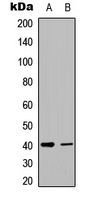
Western blot analysis of CD153 expression in Raw264.7 (A); rat kidney (B) whole cell lysates.| Product Name | CD153 antibody |
|---|---|
| Antibody Type | Primary Antibodies |
| Product description | Rabbit Polyclonal antibody to CD153The protein encoded by this gene is a cytokine that belongs to the tumor necrosis factor (TNF) ligand family. This cytokine is a ligand for TNFRSF8/CD30, which is a cell surface antigen and a marker for Hodgkin lymphoma and related hematologic malignancies. The engagement of this cytokine expressed on B cell surface plays an inhibitory role in modulating Ig class switch. This cytokine was shown to enhance cell proliferation of some lymphoma cell lines, while to induce cell death and reduce cell proliferation of other lymphoma cell lines. The pleiotropic biologic activities of this cytokine on different CD30+ lymphoma cell lines may play a pathophysiologic role in Hodgkin's and some non-Hodgkin's lymphomas. Two transcript variants encoding different isoforms have been found for this gene. [provided by RefSeq, Nov 2011] |
| Immunogen | KLH-conjugated synthetic peptide encompassing a sequence within the center region of human CD153. The exact sequence is proprietary. |
| Clonality | Polyclonal |
|---|---|
| Isotype | IgG |
| Host Species | Rabbit |
| Tested Applications | WB |
| WB:1:500~1:2000 Notes:Optimal dilutions/concentrations should be determined by the researcher. |
|
| Species Reactivity | HumanMouseRat |
| Concentration | 1mg/ml |
| Purification | Affinity purified |
| Gene Synonyms | CD30LG tumor necrosis factor superfamily member 8 CD30L TNFSF8 |
|---|---|
| Target | CD153 |
| Tissue Specificity | Recognizes endogenous levels of CD153 protein. |
Application
Western blot analysis of CD153 expression in Raw264.7 (A); rat kidney (B) whole cell lysates.| Application Notes | WB:1:500~1:2000 Notes:Optimal dilutions/concentrations should be determined by the researcher. |
|---|
| Form | Liquid |
|---|---|
| Storage Instructions | Shipped at 4 C. Upon delivery aliquot and store at -20 C for one year. Avoid freeze/thaw cycles. |
| Storage Buffer | Liquid in 0.42% Potassium phosphate; 0.87% Sodium chloride; pH 7.3; 30% glycerol; and 0.01% sodium azide. |


