Application
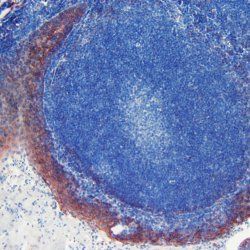
IHC analysis of human thymus tissue using CD1d antibody [NOR3.2].Application
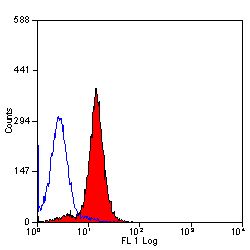
FACS analysis of MOLT4 cells using CD1d antibody [NOR3.2].| Product Name | CD1d antibody |
|---|---|
| Antibody Type | Primary Antibodies |
| Product description | Mouse monoclonal antibody [NOR3.2] to CD1dThis gene encodes a divergent member of the CD1 family of transmembrane glycoproteins, which are structurally related to the major histocompatibility complex (MHC) proteins and form heterodimers with beta-2-microglobulin. The CD1 proteins mediate the presentation of primarily lipid and glycolipid antigens of self or microbial origin to T cells. The human genome contains five CD1 family genes organized in a cluster on chromosome 1. The CD1 family members are thought to differ in their cellular localization and specificity for particular lipid ligands. The protein encoded by this gene localizes to late endosomes and lysosomes via a tyrosine-based motif in the cytoplasmic tail. [provided by RefSeq, Jul 2008] |
| Clonality | Monoclonal |
|---|---|
| Isotype | IgG1 |
| Clone Number | NOR3.2 |
| Host Species | Mouse |
| Tested Applications | FACSICC/IFIHCIHC-FIPWB |
| FACS:1:200~1:500 ICC/IF:1:200~1:500 IHC:1:50~1:200 IHC-F:1:50~1:100 IP:1:100~1:500 WB:1:500~1:2000 Notes:Optimal dilutions/concentrations should be determined by the researcher. |
|
| Species Reactivity | Human |
| Concentration | 1mg/ml |
| Purification | Affinity purified |
| Gene Synonyms | R3 CD1D CD1A |
|---|---|
| Target | CD1D |
| Tissue Specificity | This antibody recognizes the CD1d. |
Application
IHC analysis of human thymus tissue using CD1d antibody [NOR3.2].
Application
FACS analysis of MOLT4 cells using CD1d antibody [NOR3.2].| Application Notes | FACS:1:200~1:500 ICC/IF:1:200~1:500 IHC:1:50~1:200 IHC-F:1:50~1:100 IP:1:100~1:500 WB:1:500~1:2000 Notes:Optimal dilutions/concentrations should be determined by the researcher. |
|---|
| Form | Liquid |
|---|---|
| Storage Instructions | Store at +4°C or at -20°C if preferred. This product should be stored undiluted. Storage in frost free freezers is not recommended. Avoid repeated freezing and thawing as this may denature the antibody. Should this product contain a precipitate we recommend microcentrifugation before use. |
| Storage Buffer | Phosphate buffered saline containing 0.09% Sodium Azide |


