Application
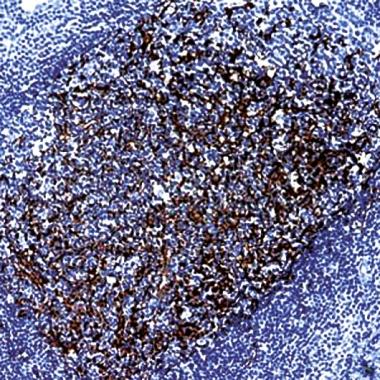
Formalin fixed paraffin embedded human tonsil stained with CD21 antibody (cat. # ).| Product Name | CD21 antibody (ready-to-use) |
|---|---|
| Antibody Type | Primary Antibodies |
| Product description | Mouse monoclonal [1F8] to CD21 predilutedCD21 also known as complement receptor 2 (CR2). C3d receptor or EBV receptor is a 140 kDa protein. CD21 is a glycosylated type I transmembrane protein consisting of an extracellular face of a series of 15 or 16 CCP domains. CD21 is the receptor for complement components C3d and iC3b as well as the Epstein-Barr virus (EBV) glycoprotein gp350/220. The soluble CD21 (sCD21) was shown to efficiently trigger CD23-signalling pathways in human monocytes. By inducing release of proinflammatory cytokines and upregulating expression of molecules involved in antigen presentation, sCD21 modulates critical monocyte functions that may be relevant to allergic and inflammatory disorders. |
| Immunogen | Purified receptor for the C3d fragment of the third complement allcomponent CR2, from human tonsil. |
| Clonality | Monoclonal |
|---|---|
| Isotype | IgG1 |
| Clone Number | 1F8 |
| Host Species | Mouse |
| Tested Applications | IHC-FIHC-P |
| IHC-P: Use at an assay dependent dilution. IHC-Fr: Use at an assay dependent dilution. We suggest an incubation period of 30 minutes at room temperature. However, depending upon the fixation conditions and the staining system employed, optimal incubation should be determined by the user. Optimal dilutions/concentrations should be determined by the end user.: |
|
| Species Reactivity | Human |
| Concentration | 1mg/ml |
| Purification | Protein A |
| Gene Synonyms | CD21 120650 1380 CR2 P20023 C3DR |
|---|---|
| Target | CD21 |
| Tissue Specificity | This antibody reacts with CD21 antigen of MW 145 kD, present on the surface of mature B cells. The antigen is present at high density on follicular dendritic cells. CD21 is involved in transmitting growth-promoting signals to the interior of the B cell. |
| Cellular Localization | Cell Membrane |
| Light Chain Type | kappa |
Application
Formalin fixed paraffin embedded human tonsil stained with CD21 antibody (cat. # ).| Positive Control | Tonsil |
|---|---|
| Application Notes | IHC-P: Use at an assay dependent dilution. IHC-Fr: Use at an assay dependent dilution. We suggest an incubation period of 30 minutes at room temperature. However, depending upon the fixation conditions and the staining system employed, optimal incubation should be determined by the user. Optimal dilutions/concentrations should be determined by the end user.: |
| Form | Liquid |
|---|---|
| Storage Instructions | Keep as concentrated solution. Store at 4ºC short term. For extended storage aliquot and store at -20ºC or below. Avoid freeze-thaw cycles. |
| Storage Buffer | Constituents: PBS |


