Application
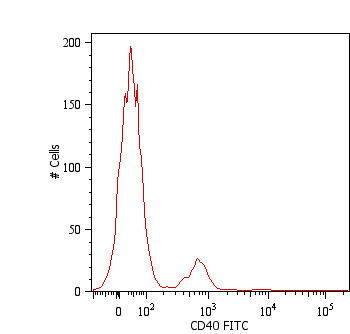
Surface staining of human peripheral blood cells with anti-human CD40: FITC . Cells in the lymphocyte gate were used for analysis.| Product Name | CD40 antibody |
|---|---|
| Antibody Type | Primary Antibodies |
| Product description | Mouse monoclonal [HI40a] to CD40CD40 (48-50 kDa) is a transmembrane glycoprotein mainly expressed on the surface of B cells and also expressed on monocytes, dendritic cells, and thymic epithelium. CD40 is a member of the tumor necrosis factor (TNF) receptor superfamily, which includes the low affinity nerve growth factor (NGF) receptor and CD95/Fas. CD40 is the receptor for CD40 ligand. CD40 ligand (CD40L, CD154, gp39, and TRAM) belongs to the TNF gene family and is expressed more widely than CD40 predominantly on activated CD4+ T cells. Following interaction with CD40 ligand, CD40 mediates a number of major immunoregulatory functions, central to the control of thymus-dependent humoral immunity and may be critical in the development of cell-mediated immune responses. Other biological actions include B cell homotypic adhesion, proliferation, immunoglobulin isotype switch, and secretion. Activation of CD40 has also been shown to inhibit the growth of certain B cell lymphomas and to induce the death of transformed cells of mesenchymal or epithelial origin. |
| Immunogen | Full length native protein (purified) (Human). |
| Clonality | Monoclonal |
|---|---|
| Isotype | IgG1 |
| Clone Number | HI40a |
| Host Species | Mouse |
| Tested Applications | FACS |
| FACS: The purified antibody is effective for indirect immunofluorescence staining of human cells by flow cytometry analysis using 0.25 mg/test Optimal dilutions/concentrations should be determined by the end user.: |
|
| Species Reactivity | Human |
| Concentration | 1mg/ml (Please refer to the vial label for the specific concentration) |
| Purification | Protein G |
| Gene Synonyms | CD40 CDW40 958 TNFRSF5 P25942 p50 109535 MGC9013 Bp50 |
|---|---|
| Target | CD40 |
| Cellular Localization | Type I membrane protein (isoforms I, III, IV and V); secreted (isoform II). |
Application
Surface staining of human peripheral blood cells with anti-human CD40: FITC . Cells in the lymphocyte gate were used for analysis.| Application Notes | FACS: The purified antibody is effective for indirect immunofluorescence staining of human cells by flow cytometry analysis using 0.25 mg/test Optimal dilutions/concentrations should be determined by the end user.: |
|---|
| Form | Liquid |
|---|---|
| Storage Instructions | Store at 2-8 ºC. For long-term storage aliquot and store at -20ºC . Avoid freeze/thaw cycles. |
| Storage Buffer | Preservative: NoneConstituents: PBS |


