Application
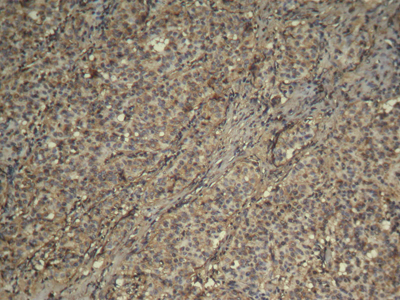
Immunohistochemical analysis of paraffin-embedded human breast carcinoma tissue using CDK4 AntibodyApplication
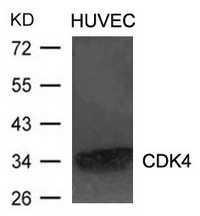
Western blot analysis of extracts from HUVEC cells using CDK4 Antibody .| Product Name | CDK4 antibody |
|---|---|
| Antibody Type | Primary Antibodies |
| Product description | Rabbit Polyclonal antibody to CDK4Cyclin-dependent kinase activity is regulated by T-loop phosphorylation (Thr172 in the case of CDK4), by the abundance of their cyclin partners, and by association with CDK inhibitors of the Cip/Kip or INK family of proteins . The inactive ternary complex of CDK4/cyclin D and p27 Kip1/Cip1 requires extracellular mitogenic stimuli for the release and degradation of p27, which affects progression through the restriction point and pRb-dependent entry into S-phase . The active complex of CDK4/cyclin D targets the retinoblastoma protein for phosphorylation, allowing the release of E2F transcription factors that activate G1/S-phase gene expression . In HeLa cells, upon UV irradiation, upregulation of p16 INK4A association with CDK4/cyclin D3 leads to a G2 delay, implicating CDK4/cyclin D3 activity in progression through the G2-phase of the cell cycle . |
| Immunogen | Peptide sequence around aa.295~299(L-H-K-D-E)derived from Human CDK4. |
| Clonality | Polyclonal |
|---|---|
| Host Species | Rabbit |
| Tested Applications | IHC-PWB |
| Suggested starting dilutions are as follows. WB: 1:500~1:1000. Not yet tested in other applications. Optimal working dilutions should be determined experimentally by the end user.: |
|
| Species Reactivity | Human |
| Concentration | 1mg/ml (Please refer to the vial label for the specific concentration) |
| Purification | Affinity purified |
| Gene Synonyms | CMM3 MGC14458 PSK-J3 CDK4 cell division protein kinase 4 cyclin-dependent kinase 4 |
|---|---|
| Target | CDK4 |
| Molecular Weight(MW) | 34 (note) |
Application
Immunohistochemical analysis of paraffin-embedded human breast carcinoma tissue using CDK4 Antibody
Application
Western blot analysis of extracts from HUVEC cells using CDK4 Antibody .| Application Notes | Suggested starting dilutions are as follows. WB: 1:500~1:1000. Not yet tested in other applications. Optimal working dilutions should be determined experimentally by the end user.: |
|---|
| Form | Liquid |
|---|---|
| Storage Instructions | Keep as concentrated solution. Aliquot and store at -20ºC or below. Avoid multiple freeze-thaw cycles. |
| Storage Buffer | saline (without Mg2+ and Ca2+), pH 7.4, 150mM NaCl, 0.02% sodium azide and 50% glycerol. |


