Application
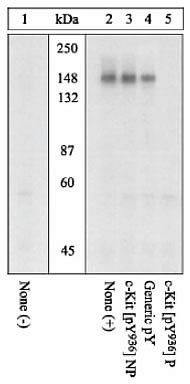
Extracts prepared from M07e cells left untreated (1) or treated (2-5) with SCF were resolved by SDS-PAGE on a 10% polyacrylamide gel and transferred to PVDF. Membranes were blocked with a 5% BSA-TBST buffer overnight at 4°C| Product Name | c-Kit (phospho Tyr936) antibody |
|---|---|
| Antibody Type | Primary Antibodies |
| Product description | Rabbit polyclonal to c - Kit ( phospho Y936 )c Kit, also known as CD117 and stem cell factor receptor, is a 145 kDa transmembrane tyrosine kinase encoded by the c Kit proto-oncogene. c Kit acts to regulate a variety of biological responses including cell proliferation, apoptosis, chemotaxis and adhesion. Ligand binding to the extracellular domain leads to autophosphorylation on several tyrosine residues within the cytoplasmic domain, and activation. c Kit mutations correlate with tumor growth and progression in a variety of cancers including mast cell disease, gastrointestinal stromal tumor, acute myeloid leukemia, Ewing sarcoma, and lung cancer. Phosphorylation at tyrosine 936 of c Kit allows binding of Grb2 and activation of the Ras, Raf, ERK1&2 signaling pathway. |
| Immunogen | Synthetic phosphopeptide derived from a region of human c Kit that contains tyrosine 936. |
| Modification | p-Tyr936 |
| Clonality | Polyclonal |
|---|---|
| Isotype | IgG |
| Host Species | Rabbit |
| Tested Applications | WB |
| WB: Use at a dilution of 1/1000. Detects a band of approximately 145 kDa. Can be blocked with GTX25749 Kit (c-Kit) phospho Y936 and non-phospho peptides (pair) Optimal dilutions/concentrations should be determined by the end user. | |
| Species Reactivity | Human |
| Concentration | 1mg/ml |
| Purification | Affinity purified |
| Gene Synonyms | CKit, KIT, CD117, P10721, SCFR, C-Kit, PBT, 164920, 3815, c Kit, c-Kit (phospho Y936), c-Kit (phospho Tyr936), c-Kit (pY936), c-Kit (pTyr936), c-Kit phospho Y936, c-Kit phospho Tyr936, Phospho c-Kit (Y936), Phospho c-Kit (Tyr936), Phospho c-Kit (pY936), P |
|---|---|
| Target | c-Kit |
| Cellular Localization | Type I membrane protein. |
Application
Extracts prepared from M07e cells left untreated (1) or treated (2-5) with SCF were resolved by SDS-PAGE on a 10% polyacrylamide gel and transferred to PVDF. Membranes were blocked with a 5% BSA-TBST buffer overnight at 4°C| Positive Control | M07e cells + or - SCF |
|---|---|
| Application Notes | WB: Use at a dilution of 1/1000. Detects a band of approximately 145 kDa. Can be blocked with GTX25749 Kit (c-Kit) phospho Y936 and non-phospho peptides (pair) Optimal dilutions/concentrations should be determined by the end user. |
| Form | Liquid |
|---|---|
| Storage Instructions | For short-term storage, store at 4° C. For long-term storage, aliquot and store at -20ºC or below. Avoid multiple freeze-thaw cycles. |
| Storage Buffer | Preservative: 0.05% Sodium Azide; Constituents: 50% Glycerol, PBS, 1mg/ml BSA. pH 7.3 |


