Application
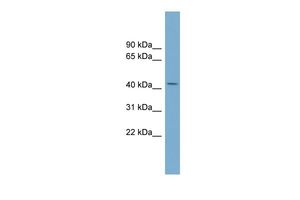
WB analysis of human spleen tissue using COX10 antibody at 0.2-1μg/ml.| Product Name | COX10 antibody, Internal |
|---|---|
| Antibody Type | Primary Antibodies |
| Product description | Rabbit Polyclonal antibody to COX10Cytochrome c oxidase (COX), the terminal component of the mitochondrial respiratory chain, catalyzes the electron transfer from reduced cytochrome c to oxygen. This component is a heteromeric complex consisting of 3 catalytic subunits encoded by mitochondrial genes and multiple structural subunits encoded by nuclear genes. The mitochondrially-encoded subunits function in electron transfer, and the nuclear-encoded subunits may function in the regulation and assembly of the complex. This nuclear gene encodes heme A:farnesyltransferase, which is not a structural subunit but required for the expression of functional COX and functions in the maturation of the heme A prosthetic group of COX. This protein is predicted to contain 7-9 transmembrane domains localized in the mitochondrial inner membrane. A gene mutation, which results in the substitution of a lysine for an asparagine (N204K), is identified to be responsible for cytochrome c oxidase deficiency. In addition, this gene is disrupted in patients with CMT1A (Charcot-Marie-Tooth type 1A) duplication and with HNPP (hereditary neuropathy with liability to pressure palsies) deletion. [provided by RefSeq, Jul 2008] |
| Immunogen | A synthetic peptide corresponding to an Internal region of Human COX10 |
| Clonality | Polyclonal |
|---|---|
| Isotype | IgG |
| Host Species | Rabbit |
| Tested Applications | WB |
| *Optimal dilutions/concentrations should be determined by the researcher. | |
| Species Reactivity | Human |
| Predicted Reactivity | Cow: 100%; Dog: 100%; Guinea Pig: 100%; Horse: 100%; Human: 100%; Mouse: 100%; Rabbit: 100%; Rat: 100%; Yeast: 83%; Zebrafish: 100% |
| Concentration | 1mg/ml |
| Purification | Affinity purified |
| Gene Synonyms | COX10 |
|---|---|
| Target | COX10 |
| Molecular Weight(MW) | 49 KDa (note) |
Application
WB analysis of human spleen tissue using COX10 antibody at 0.2-1μg/ml.| Application Notes | *Optimal dilutions/concentrations should be determined by the researcher. |
|---|
| Form | Liquid |
|---|---|
| Storage Instructions | Keep as concentrated solution. For short-term storage, store at 4ºC. For long-term storage, aliquot and store at -20ºC or below. Avoid multiple freeze-thaw cycles. |
| Storage Buffer | 1x PBS buffer with 0.09% (w/v) sodium azide and 2% sucrose. |


