Application
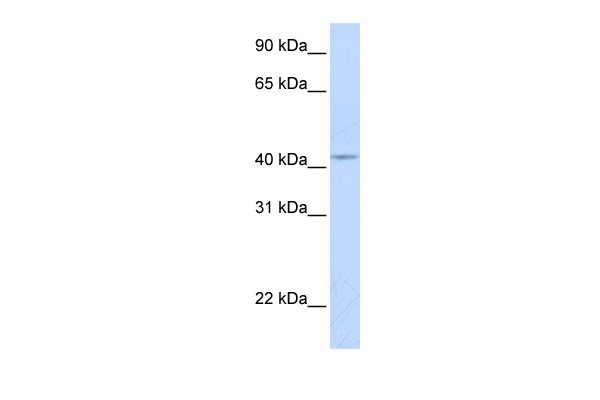
Antibody used in WB on Human Lung at 0.2-1 ug/ml.Application
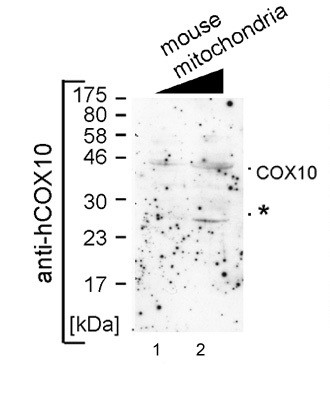
Antibody used in WB on mouse mitochondria at 1:1000.Application
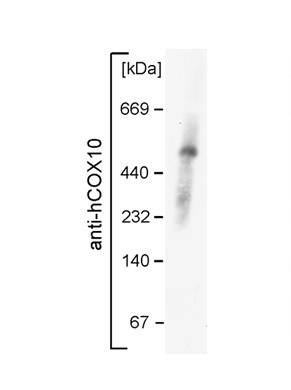
Antibody used in WB on mouse mitochondria at 1:1000.| Product Name | COX10 Antibody |
|---|---|
| Antibody Type | Primary Antibodies |
| Antigen Alias | COX10, |
| Product description | Cytochrome c oxidase (COX), the terminal component of the mitochondrial respiratory chain, catalyzes the electron transfer from reduced cytochrome c to oxygen. COX10 is heme A: farnesyltransferase, which is not a structural subunit but required for the expression of functional COX and functions in the maturation of the heme A prosthetic group of COX. This protein is predicted to contain 7-9 transmembrane domains localized in the mitochondrial inner membrane. A gene mutation, which results in the substitution of a lysine for an asparagine (N204K), is identified to be responsible for cytochrome c oxidase deficiency. In addition, this gene is disrupted in patients with CMT1A (Charcot-Marie-Tooth type 1A) duplication and with HNPP (hereditary neuropathy with liability to pressure palsies) deletion.Cytochrome c oxidase (COX), the terminal component of the mitochondrial respiratory chain, catalyzes the electron transfer from reduced cytochrome c to oxygen. This component is a heteromeric complex consisting of 3 catalytic subunits encoded by mitochondrial genes and multiple structural subunits encoded by nuclear genes. The mitochondrially-encoded subunits function in electron transfer, and the nuclear-encoded subunits may function in the regulation and assembly of the complex. This nuclear gene encodes heme A:farnesyltransferase, which is not a structural subunit but required for the expression of functional COX and functions in the maturation of the heme A prosthetic group of COX. This protein is predicted to contain 7-9 transmembrane domains localized in the mitochondrial inner membrane. A gene mutation, which results in the substitution of a lysine for an asparagine (N204K), is identified to be responsible for cytochrome c oxidase deficiency. In addition, this gene is disrupted in patients with CMT1A (Charcot-Marie-Tooth type 1A) duplication and with HNPP (hereditary neuropathy with liability to pressure palsies) deletion. Publication Note: This RefSeq record includes a subset of the publications that are available for this gene. Please see the Entrez Gene record to access additional publications.1) Veluthakal, R., (2007) Diabetes 56 (1), 204-210. |
| Immunogen | Antibody produced in rabbits immunized with a synthetic peptide corresponding a region of human COX10. |
| Clonality | Polyclonal |
|---|---|
| Host Species | Rabbit |
| Tested Applications | ELISAWB |
| COX10 antibody can be used for detection of COX10 by ELISA at 1:312500. COX10 antibody can be used for detection of COX10 by western blot at 1 μg/mL, and HRP conjugated secondary antibody should be diluted 1:50,000 - 100,000.: |
|
| Species Reactivity | HumanMouseRat |
| Concentration | 1mg/ml |
| Purification | Affinity purified |
| Gene Symbol | COX10 |
|---|---|
| Alternative Names | COX10 |
| Molecular Weight(MW) | 49 kDa |
Application
Antibody used in WB on Human Lung at 0.2-1 ug/ml.
Application
Antibody used in WB on mouse mitochondria at 1:1000.
Application
Antibody used in WB on mouse mitochondria at 1:1000.| Positive Control | 1) Cat. No. XBL-10410 - Fetal Lung Tissue Lysate |
|---|---|
| Application Notes | COX10 antibody can be used for detection of COX10 by ELISA at 1:312500. COX10 antibody can be used for detection of COX10 by western blot at 1 μg/mL, and HRP conjugated secondary antibody should be diluted 1:50,000 - 100,000.: |
| Form | Liquid |
|---|---|
| Storage Instructions | For short periods of storage (days) store at 4˚C. For longer periods of storage, store COX10 antibody at -20˚C. As with any antibody avoid repeat freeze-thaw cycles. |
| Storage Buffer | Antibody is lyophilized in PBS buffer with 2% sucrose. Add 50 μL of distilled water. Final antibody concentration is 1 mg/mL. |


