Application
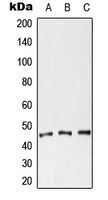
Western blot analysis of CXADR expression in HeLa (A); NIH3T3 (B); H9C2 (C) whole cell lysates.Application
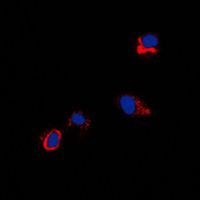
Immunofluorescent analysis of CXADR staining in NIH3T3 cells. Formalin-fixed cells were permeabilized with 0.1% Triton X-100 in TBS for 5-10 minutes and blocked with 3% BSA-PBS for 30 minutes at room temperature. Cells were probed with the primary antibody in 3% BSA-PBS and incubated overnight at 4 C in a humidified chamber. Cells were washed with PBST and incubated with a DyLight 594-conjugated secondary antibody (red) in PBS at room temperature in the dark. DAPI was used to stain the cell nuclei (blue).| Product Name | Coxsackie Adenovirus Receptor antibody |
|---|---|
| Antibody Type | Primary Antibodies |
| Product description | Rabbit Polyclonal antibody to Coxsackie Adenovirus ReceptorThe protein encoded by this gene is a type I membrane receptor for group B coxsackieviruses and subgroup C adenoviruses. Several transcript variants encoding different isoforms have been found for this gene. Pseudogenes of this gene are found on chromosomes 15, 18, and 21. [provided by RefSeq, May 2011] |
| Immunogen | KLH-conjugated synthetic peptide encompassing a sequence within the N-term region of human Coxsackie Adenovirus Receptor. The exact sequence is proprietary. |
| Clonality | Polyclonal |
|---|---|
| Isotype | IgG |
| Host Species | Rabbit |
| Tested Applications | ICC/IFWB |
| Species Reactivity | HumanMouseRat |
| Concentration | 1mg/ml |
| Purification | Affinity purified |
| Gene Synonyms | CXADR , CAR4/6 , HCAR , coxsackie virus and adenovirus receptor |
|---|---|
| Target | Coxsackie Adenovirus Receptor |
| Tissue Specificity | Recognizes endogenous levels of Coxsackie Adenovirus Receptor protein. |
Application
Western blot analysis of CXADR expression in HeLa (A); NIH3T3 (B); H9C2 (C) whole cell lysates.
Application
Immunofluorescent analysis of CXADR staining in NIH3T3 cells. Formalin-fixed cells were permeabilized with 0.1% Triton X-100 in TBS for 5-10 minutes and blocked with 3% BSA-PBS for 30 minutes at room temperature. Cells were probed with the primary antibody in 3% BSA-PBS and incubated overnight at 4 C in a humidified chamber. Cells were washed with PBST and incubated with a DyLight 594-conjugated secondary antibody (red) in PBS at room temperature in the dark. DAPI was used to stain the cell nuclei (blue).| Form | Liquid |
|---|---|
| Storage Instructions | Shipped at 4 C. Upon delivery aliquot and store at -20 C for one year. Avoid freeze/thaw cycles. |
| Storage Buffer | Liquid in 0.42% Potassium phosphate; 0.87% Sodium chloride; pH 7.3; 30% glycerol; and 0.01% sodium azide. |


