Application
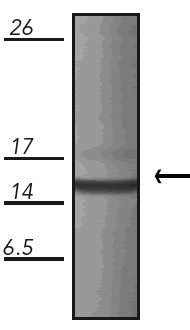
Western blot analysis of chlamydia-infected human HeLa cell lysate, probed with| Product Name | Cpn10 antibody |
|---|---|
| Antibody Type | Primary Antibodies |
| Product description | Mouse monoclonal [M1.2] to Cpn10Homologs of E. coli GroES make up a family of small heat shock proteins with an approximate molecular mass of 10 kDa (Hsp10s). Cpn10 acts as a cochaperone and interacts with members of the Hsp60 family (GroEL in E. coli) to promote proper folding of polypeptides. In chlamydia, Cpn10 is thought to interact with cHsp60, a reported immunopathological antigen, identifying cpn10 as a potential contributor to an immunological response. |
| Immunogen | A 16 residue synthetic MAP peptide KKDDKGQQLPFEVQVG based on C. trachomatis cpn10 (residues 54-69). |
| Clonality | Monoclonal |
|---|---|
| Isotype | IgG2a |
| Clone Number | M1.2 |
| Host Species | Mouse |
| Tested Applications | EIAIPWB |
| EIA: Use at an assay dependent dilution. IP: Use at an assay dependent dilution. WB: Use at a concentration of 0.25 μg/ml. Detects a band of approximately 15 kDa (predicted molecular weight: 9.9 kDa). Optimal dilutions/concentrations should be determined by the end user.: |
|
| Species Reactivity | Human |
| Concentration | 1mg/ml |
| Purification | Protein G |
| Gene Synonyms | Cpn10 HSPE1 3336 GROES HSP10 600141 P61604 EPF |
|---|---|
| Target | Cpn10 |
| Tissue Specificity | This antibody will not react with the human or mouse cpn10 homolog nor with E. coli GroES. |
| Cellular Localization | Mitochondrial |
Application
Western blot analysis of chlamydia-infected human HeLa cell lysate, probed with| Application Notes | EIA: Use at an assay dependent dilution. IP: Use at an assay dependent dilution. WB: Use at a concentration of 0.25 μg/ml. Detects a band of approximately 15 kDa (predicted molecular weight: 9.9 kDa). Optimal dilutions/concentrations should be determined by the end user.: |
|---|
| Form | Liquid |
|---|---|
| Storage Instructions | Keep as concentrated solution. Store at 4ºC short term. For extended storage aliquot and store at -20ºC or below. Avoid freeze-thaw cycles. |
| Storage Buffer | Preservative: NoneConstituents: PBS, 0.1mM PMSF |


