Application
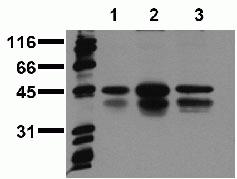
Whole cell extracts of human A549 cells (approximately 20,000 cells per lane) untreated (1), stimulated with EGF (2) or treated with pervanadate (3), were resolved by SDS-PAGE and transferred to PVDF. Whole cell extracts of human A549 cells (approximately 20,000 cells per lane) untreated (1), stimulated with EGF (2) or treated with pervanadate (3), were resolved by SDS-PAGE and transferred to PVDF. The membrane was blocked with a casein/Tween 20 buffer, then incubated with mouse anti-CREB/ATF1 [pS133] antibody at 0.5 µg/mL for 1 hour at room temperature. After washing, the membrane was incubated with an anti-mouse HRP-conjugated secondary antibody and signals were detected using an ECL detection method (exposure time: 30 seconds).Application
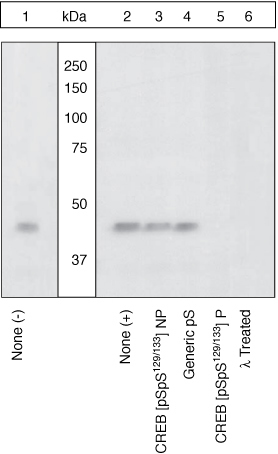
'Up-regulation and Antibody-Peptide Competition. Peptide Competition and Phosphatase Treatment. Extracts of NIH3T3 cells untreated (1) or treated with 50ng/mLPDGF for 15 minutes (2-6) were resolved by SDS-PAGE on a 10% Tris-glycine gel and transferred to PVDF. The membrane was blocked with a 5% BSA-TBST buffer for one hour at room temperature and either left untreated (1-5) or treated with lambda phosphatase (6), then incubated with the CREB antibody for two hours at room temperature in a 3% BSA-TBST buffer, following prior incubation with: no peptide (1, 2, 6), the non-phosphopeptide corresponding to the phosphopeptide immunogen (3), a generic phosphoserine-containing peptide (4), or the phosphopeptide immunogen (5). After washing, the membrane was incubated with goat F(ab’)2 anti-rabbit IgG HRP conjugate and signals were detected. The data show that only the phosphopeptide corresponding to CREB [pSpS129/133] blocks the antibody signal, demonstrating the specificity of the antibody. The data also show that phosphatase stripping eliminates the signal, further verifying that the antibody is phospho-specific. Note: Pretreatment of cells with PKA inhibitor (PKI) or GSK-3beta inhibitor (LiCl) diminished the signal, indicating the dual phosphoreactivity of this antibody (data not shown).'| Product Name | CREB (phospho Ser129/Ser133) antibody |
|---|---|
| Antibody Type | Primary Antibodies |
| Product description | Rabbit polyclonal to CREB ( phospho S129 + S133 )Cyclic AMP Response Element Binding protein (CREB) is a basic / leucine zipper transcription factor that binds the cyclic AMP response element (CRE) and activates transcription in response to a variety of extracellular signals including neurotransmitters, hormones, membrane depolarization, and growth and neurotrophic factors. Activation of CREB is dependent upon the phosphorylation of serine 133. Phosphorylation occurs via p44 / 42 MAP kinase and p90RSK and also via p38 MAP kinase and MSK 1. Although CREB will bind DNA independent of its phosphorylation state, only the phosphorylated form is competent as a transcription factor. CREB binding protein (CBP), a transcriptional coactivator that directly interacts with CREB, binds to CREB in the region of serine 133. CREB appears to play an important role in learning and memory. Alternate splicing of this gene results in two transcript variants encoding different isoforms. |
| Immunogen | Synthetic peptide (Human). |
| Modification | p-Ser129/Ser133 |
| Clonality | Polyclonal |
|---|---|
| Isotype | IgG |
| Host Species | Rabbit |
| Tested Applications | WB |
| WB: Use at a dilution of 1/1000. Detects a band of approximately 43 kDa. Optimal dilutions/concentrations should be determined by the end user. | |
| Species Reactivity | HumanMouseRat |
| Concentration | 1mg/ml |
| Purification | Affinity purified |
| Gene Synonyms | 123810, P16220, MGC9284, CREB, 1385, CREB1, CREB (phospho S129/S133), CREB (phospho Ser129/Ser133), CREB (pS129/pS133), CREB (pSer129/pSer133), CREB phospho S129/S133, CREB phospho Ser129/Ser133, Phospho CREB (S129/S133), Phospho CREB (Ser129/Ser133), Pho |
|---|---|
| Target | CREB |
| Molecular Weight(MW) | 43-45 KD |
| Cellular Localization | Nuclear |
Application
Whole cell extracts of human A549 cells (approximately 20,000 cells per lane) untreated (1), stimulated with EGF (2) or treated with pervanadate (3), were resolved by SDS-PAGE and transferred to PVDF. Whole cell extracts of human A549 cells (approximately 20,000 cells per lane) untreated (1), stimulated with EGF (2) or treated with pervanadate (3), were resolved by SDS-PAGE and transferred to PVDF. The membrane was blocked with a casein/Tween 20 buffer, then incubated with mouse anti-CREB/ATF1 [pS133] antibody at 0.5 µg/mL for 1 hour at room temperature. After washing, the membrane was incubated with an anti-mouse HRP-conjugated secondary antibody and signals were detected using an ECL detection method (exposure time: 30 seconds).
Application
'Up-regulation and Antibody-Peptide Competition. Peptide Competition and Phosphatase Treatment. Extracts of NIH3T3 cells untreated (1) or treated with 50ng/mLPDGF for 15 minutes (2-6) were resolved by SDS-PAGE on a 10% Tris-glycine gel and transferred to PVDF. The membrane was blocked with a 5% BSA-TBST buffer for one hour at room temperature and either left untreated (1-5) or treated with lambda phosphatase (6), then incubated with the CREB antibody for two hours at room temperature in a 3% BSA-TBST buffer, following prior incubation with: no peptide (1, 2, 6), the non-phosphopeptide corresponding to the phosphopeptide immunogen (3), a generic phosphoserine-containing peptide (4), or the phosphopeptide immunogen (5). After washing, the membrane was incubated with goat F(ab’)2 anti-rabbit IgG HRP conjugate and signals were detected. The data show that only the phosphopeptide corresponding to CREB [pSpS129/133] blocks the antibody signal, demonstrating the specificity of the antibody. The data also show that phosphatase stripping eliminates the signal, further verifying that the antibody is phospho-specific. Note: Pretreatment of cells with PKA inhibitor (PKI) or GSK-3beta inhibitor (LiCl) diminished the signal, indicating the dual phosphoreactivity of this antibody (data not shown).'| Application Notes | WB: Use at a dilution of 1/1000. Detects a band of approximately 43 kDa. Optimal dilutions/concentrations should be determined by the end user. |
|---|
| Form | Liquid |
|---|---|
| Storage Instructions | Aliquot and store at -20 °C or -80 °C. Avoid repeated freeze / thaw cycles. |
| Storage Buffer | Preservative: 0.05% Sodium Azide; Constituents: 50% Glycerol, 1mg/ml BSA, PBS and Ca. pH 7.3 |


