Application
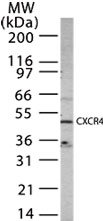
Western blot analysis of 15 µg of whole cell lysate from HeLa cells with anti-CXCR4 at 1 ug/ml.| Product Name | CXCR4 antibody |
|---|---|
| Antibody Type | Primary Antibodies |
| Product description | Rabbit polyclonal to CXCR4CXCR4 (fusin, LESTR or HUMSTR) is a principal coreceptor for T-cell tropic strains of HIV-1 fusion and entry of human white blood cells. CXCR4 is also required for the infection by dual-tropic strains of HIV-1 and mediates CD4 independent infection by HIV-2. The a-chemokine SDF-1 is the ligand for CXCR4 and prevents infection by T-tropic HIV-1. CXCR4 associates with the surface CD4-gp120 complex before HIV enters target cells. CXCR4 messenger RNA levels correlated with HIV-1 permissiveness in diverse human cell types. Antibodies to CXCR4 block HIV-1 and HIV-2 fusion and infection of human target cells. The amino-terminal domain and the second extracellular loop of CXCR4 serve as HIV biding sites.CXCR4 is highly expressed in brain and heart, and in white blood cells, vascular endothelial cells, and umbilical cord endothelial cells. |
| Immunogen | Synthetic peptide: ILSKGKRGGHS, corresponding to amino acids 328-338 of Human CXCR4. |
| Clonality | Polyclonal |
|---|---|
| Isotype | IgG |
| Host Species | Rabbit |
| Tested Applications | WB |
| WB: Use at a concentration of 1 - 2 μg/ml. Detects a band of approximately 45 kDa (predicted molecular weight: 42 kDa). Optimal dilutions/concentrations should be determined by the end user.: |
|
| Species Reactivity | HumanMouseRat |
| Concentration | 0.5mg/ml |
| Purification | Protein G |
| Gene Synonyms | WHIM NPY3R NPYY3R FB22 LAP3 LCR1 162643 NPYR 7852 HM89 HSY3RR P61073 NPYRL CD184 D2S201E LESTR CXCR4 |
|---|---|
| Target | CXCR4 |
| Cellular Localization | Cell Membrane |
Application
Western blot analysis of 15 µg of whole cell lysate from HeLa cells with anti-CXCR4 at 1 ug/ml.| Positive Control | Whole cell lysate from HeLa cells. |
|---|---|
| Application Notes | WB: Use at a concentration of 1 - 2 μg/ml. Detects a band of approximately 45 kDa (predicted molecular weight: 42 kDa). Optimal dilutions/concentrations should be determined by the end user.: |
| Form | Liquid |
|---|---|
| Storage Instructions | Keep as concentrated solution. Store at 4ºC short term. For extended storage aliquot and store at -20ºC or below. Avoid freeze-thaw cycles. |
| Storage Buffer | Preservative: 0.05% Sodium AzideConstituents: 0.2% Gelatin, PBS |


