Application
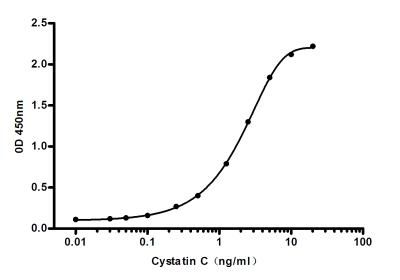
ELISA analysis of human Cystatin C (4μg/ml) using Cystatin C antibody [6F12-C7-D8] for capture and Cystatin C antibody [7F6-A5-F3] for detection.| Product Name | Cystatin C antibody |
|---|---|
| Antibody Type | Primary Antibodies |
| Product description | Mouse Monoclonal antibody [6F12-C7-D8] to Cystatin CThe cystatin superfamily encompasses proteins that contain multiple cystatin-like sequences. Some of the members are active cysteine protease inhibitors, while others have lost or perhaps never acquired this inhibitory activity. There are three inhibitory families in the superfamily, including the type 1 cystatins (stefins), type 2 cystatins and the kininogens. The type 2 cystatin proteins are a class of cysteine proteinase inhibitors found in a variety of human fluids and secretions, where they appear to provide protective functions. The cystatin locus on chromosome 20 contains the majority of the type 2 cystatin genes and pseudogenes. This gene is located in the cystatin locus and encodes the most abundant extracellular inhibitor of cysteine proteases, which is found in high concentrations in biological fluids and is expressed in virtually all organs of the body. A mutation in this gene has been associated with amyloid angiopathy. Expression of this protein in vascular wall smooth mu |
| Immunogen | Recombinant human cystatin c protein. |
| Clonality | Monoclonal |
|---|---|
| Isotype | IgG1 |
| Clone Number | 6F12-C7-D8 |
| Host Species | Mouse |
| Tested Applications | ELISA |
| Notes:Optimal dilutions/concentrations should be determined by the researcher. |
|
| Species Reactivity | Human |
| Concentration | 1mg/ml |
| Gene Synonyms | cystatin C ARMD11 CST3 |
|---|---|
| Target | Cystatin C |
Application
ELISA analysis of human Cystatin C (4μg/ml) using Cystatin C antibody [6F12-C7-D8] for capture and Cystatin C antibody [7F6-A5-F3] for detection.| Application Notes | Notes:Optimal dilutions/concentrations should be determined by the researcher. |
|---|
| Form | Liquid |
|---|---|
| Storage Instructions | For short-term storage, store at 4° C. For long-term storage, aliquot and store at -20ºC or below. Avoid multiple freeze-thaw cycles. |
| Storage Buffer | phosphate buffered saline , pH 7.4, 150mM NaCl, 0.02% sodium azide and 50% glycerol. |


