Application
ApplicationApplication
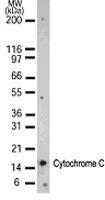
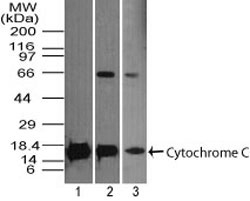
Western blot analysis using cytochrome C antibody. Human HeLa lysate probed with cytochrome C antibody at 0.1 ug/ml.| Product Name | Cytochrome C antibody |
|---|---|
| Antibody Type | Primary Antibodies |
| Product description | Mouse monoclonal [7H8.2C12] to Cytochrome CCytochrome C is an electron transporting protein that resides within the intermembrane space of the mitochondria, where it plays a critical role in the process of oxidative phosphorylation and production of cellular ATP. An increasing amount of interest has been directed toward the role which cytocrome C has been demonstrated to play in apoptotic processes. Following exposure to apoptotic stimuli, cytochrome C is rapidly released from the mitochondria into the cytosol, an event which may be required for the completion of apoptosis in some systems. Cytosolic cytochrome C functions in the activation of caspase 3, an ICE family molecule that is a key effector of apoptosis. |
| Immunogen | Synthetic peptides corresponding to amino acids 1-80, 81-104 and 66-104 of pigeon CYT. |
| Clonality | Monoclonal |
|---|---|
| Isotype | IgG2 |
| Clone Number | 7H8.2C12 |
| Host Species | Mouse |
| Tested Applications | WB |
| For WB: Use at a dilution of 1:500 - 1:1,000. Predicted molecular weight: 15 kDa. Optimal dilutions/concentrations should be determined by the researcher.: |
|
| Species Reactivity | HumanMouseDrosophilaPigRatHamsterHorsePigeon |
| Concentration | 0.5mg/ml |
| Purification | Protein G |
| Gene Synonyms | CYC 123970 54205 CYCS Cytochrome C P99999 HCS |
|---|---|
| Target | Cytochrome C |
| Cellular Localization | Cytoplasmic and Mitochondrial |
Application
Application
Application
Western blot analysis using cytochrome C antibody. Human HeLa lysate probed with cytochrome C antibody at 0.1 ug/ml.| Positive Control | HeLa |
|---|---|
| Application Notes | For WB: Use at a dilution of 1:500 - 1:1,000. Predicted molecular weight: 15 kDa. Optimal dilutions/concentrations should be determined by the researcher.: |
| Form | Liquid |
|---|---|
| Storage Instructions | Keep as concentrated solution. Store at 4ºC short term. For extended storage aliquot and store at -20ºC or below. Avoid freeze-thaw cycles. |
| Storage Buffer | Phosphate-buffered saline containing 0.5% BSA and 0.05% sodium azide |


