Application
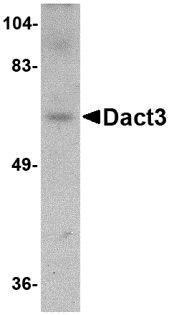
Western blot analysis of Dact3 in rat brain tissue lysate with Dact3 antibody at 1 ug/ml.| Product Name | Dact3 antibody |
|---|---|
| Antibody Type | Primary Antibodies |
| Product description | Rabbit polyclonal antibody to Dact3The Wnt signaling cascade is a conserved process in multicellular animals that plays important roles during development and can contribute to cancer and other diseases. Many members of this pathway are also expressed in the postnatal tissues such as brain. One such protein is Dact3, a member of the Dact protein family that was initially identified through binding to Disheveled (Dvl), a cytoplasmic protein essential to Wnt signaling. Dact3 is expressed in the ventral region of maturing somites, limb bud and branchial arch mesenchyme, embryonic CNS, and the adult brain. Recent evidence shows that Dact3 acts as a negative regulator Wnt/b-catenin signaling that is repressed at the transcriptional level in colorectal cancer and this repression is associated with bivalent histone modifications. This repression can be reversed by pharmacological agents that targets both histone methylation and deacetylation, suggesting that Dact3 may be a potential target for therapeutic treatment of this cancer. At least three isoforms of Dact3 are known to exist. |
| Clonality | Polyclonal |
|---|---|
| Host Species | Rabbit |
| Tested Applications | ELISAWB |
| WB:1:500~1:2000 Notes:Optimal dilutions/concentrations should be determined by the researcher. |
|
| Species Reactivity | HumanMouseRat |
| Concentration | 1mg/ml |
| Purification | Affinity purified |
| Gene Synonyms | Dact3 RRR3 Dapper antagonist of beta-catenin 3 Dapper antagonist of betacatenin3 Dapper homolog3 Dapper antagonist of betacatenin 3 Dapper homolog 3 |
|---|---|
| Target | Dact3 |
| Tissue Specificity | This antibody is specific for Dact3 |
Application
Western blot analysis of Dact3 in rat brain tissue lysate with Dact3 antibody at 1 ug/ml.| Positive Control | Blocking Peptide: Cat.No. GTX85372-PEP - Dact3 Peptide Lysates: Cat. No. GTX27942 - Rat Brain Tissue Lysate |
|---|---|
| Application Notes | WB:1:500~1:2000 Notes:Optimal dilutions/concentrations should be determined by the researcher. |
| Form | Liquid |
|---|---|
| Storage Instructions | Keep as concentrated solution. Aliquot and store at -20ºC or below. Avoid multiple freeze-thaw cycles. |
| Storage Buffer | PBS containing 0.02% sodium azide |


