Application
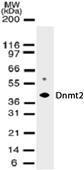
Western blot analysis for Dnmt2 using at 2 g/ml dilution against 15 g of transfected cell lysate.| Product Name | DNMT2 antibody |
|---|---|
| Antibody Type | Primary Antibodies |
| Product description | Mouse monoclonal [102B1259.2] to DNMT2Methylation of DNA at cytosine residues plays an important role in regulation of gene expression, genomic imprinting and is essential for mammalian development. Hypermethylation of CpG islands in tumor suppressor genes or hypomethylation of bulk genomic DNA may be linked with development of cancer. To date, 3 families of mammalian DNA methyltransferase genes have been identified which include Dnmt1, Dnmt2 and Dnmt3. Dnmt1 is constitutively expressed in proliferating cells and inactivation of this gene causes global demethylation of genomic DNA and embryonic lethality. Dnmt2 is expressed at low levels in adult tissues and its inactivation does not affect DNA methylation or maintenance of methylation. The Dnmt3 family members, Dnmt3a and Dnmt3b, are strongly expressed in ES cells but their expression is down regulated in differentiating ES cells and is low in adult somatic tissue. Dnmt1 co-purifies with the retinoblastoma (Rb) tumour suppressor gene product, E2F1, and HDAC1. Dnmt1 also cooperates with Rb to repress transcription from promoters containing E2Fbinding sites suggesting a link between DNA methylation, histone deacetylase and sequence-specific DNA binding activity, as well as a growth-regulatory pathway that is disrupted in nearly all cancer cells. |
| Immunogen | Synthetic peptides (Mouse). |
| Clonality | Monoclonal |
|---|---|
| Isotype | IgG |
| Clone Number | 102B1259.2 |
| Host Species | Mouse |
| Tested Applications | WB |
| WB: Use at a concentration of 1 - 3 μg/ml. Detects a band of approximately 42 kDa. Optimal dilutions/concentrations should be determined by the end user.: |
|
| Species Reactivity | Mouse |
| Concentration | 0.5mg/ml |
| Purification | Protein G |
| Gene Synonyms | 1787 O14717 602478 PuMet 13434 M.HsaIIP DNMT2 |
|---|---|
| Target | Dnmt2 |
| Cellular Localization | Nuclear |
Application
Western blot analysis for Dnmt2 using at 2 g/ml dilution against 15 g of transfected cell lysate.| Application Notes | WB: Use at a concentration of 1 - 3 μg/ml. Detects a band of approximately 42 kDa. Optimal dilutions/concentrations should be determined by the end user.: |
|---|
| Form | Liquid |
|---|---|
| Storage Instructions | Keep as concentrated solution. Store at 4ºC short term. For extended storage aliquot and store at -20ºC or below. Avoid freeze-thaw cycles. |
| Storage Buffer | Preservative: 0.05% Sodium Azide; Constituents: 0.2% Gelatin, PBS |


