Application
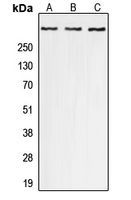
Western blot analysis of p300 (pS1834) expression in A549 (A); Raw264.7 (B); PC12 (C) whole cell lysates.| Product Name | EP300 (phospho Ser1834) antibody |
|---|---|
| Antibody Type | Primary Antibodies |
| Product description | Rabbit Polyclonal antibody to EP300 (phospho Ser1834)This gene encodes the adenovirus E1A-associated cellular p300 transcriptional co-activator protein. It functions as histone acetyltransferase that regulates transcription via chromatin remodeling and is important in the processes of cell proliferation and differentiation. It mediates cAMP-gene regulation by binding specifically to phosphorylated CREB protein. This gene has also been identified as a co-activator of HIF1A (hypoxia-inducible factor 1 alpha), and thus plays a role in the stimulation of hypoxia-induced genes such as VEGF. Defects in this gene are a cause of Rubinstein-Taybi syndrome and may also play a role in epithelial cancer. [provided by RefSeq, Jul 2008] |
| Immunogen | KLH-conjugated synthetic peptide encompassing a sequence within the C-term region of human p300 (pS1834). The exact sequence is proprietary. |
| Modification | p-Ser1834 |
| Clonality | Polyclonal |
|---|---|
| Isotype | IgG |
| Host Species | Rabbit |
| Tested Applications | WB |
| WB: 1:500 - 1:1000: |
|
| Species Reactivity | HumanMouseRat |
| Concentration | 1mg/ml |
| Purification | Affinity purified |
| Gene Synonyms | E1A binding protein p300 p300 RSTS2 EP300 KAT3B |
|---|---|
| Target | EP300 (phospho Ser1834) |
| Tissue Specificity | Recognizes endogenous levels of p300 (pS1834) protein. |
Application
Western blot analysis of p300 (pS1834) expression in A549 (A); Raw264.7 (B); PC12 (C) whole cell lysates.| Application Notes | WB: 1:500 - 1:1000: |
|---|
| Form | Liquid |
|---|---|
| Storage Instructions | Shipped at 4 °C. Upon delivery aliquot and store at -20 °C for one year. Avoid freeze/thaw cycles. |
| Storage Buffer | Liquid in 0.42% Potassium phosphate; 0.87% Sodium chloride; pH 7.3; 30% glycerol; and 0.01% sodium azide. |


