Application
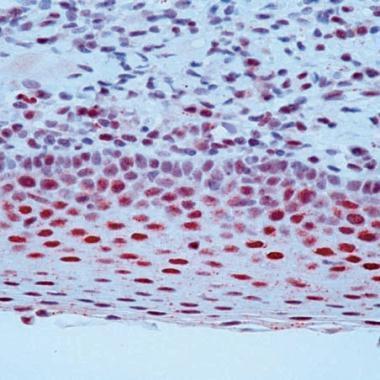
IHC Image using - Detection of ERCC1 by IHC in Human Tonsil| Product Name | ERCC1 antibody |
|---|---|
| Antibody Type | Primary Antibodies |
| Product description | Mouse monoclonal [8F1] to ERCC1ERCC1 is required for nucleotide excision repair of damaged DNA and is homologous to RAD10. In mammalian cells, XPG cleaves 3' of the DNA lesion while ERCC1-XPF complex makes the 5' incision. |
| Immunogen | Recombinant full length protein |
| Clonality | Monoclonal |
|---|---|
| Isotype | IgG2 |
| Clone Number | 8F1 |
| Host Species | Mouse |
| Tested Applications | IHCIHC-FIHC-PIPWB |
| IHC: This antibody may be diluted to a titer of 1:50-1:100 in an ABC method. We suggest an incubation period of 30 minutes at room temperature. However, depending upon the fixation conditions and the staining system employed, optimal incubation conditions and antibody dilutions should be determined by the user. Formalin fixed paraffin embedded tissue sections require high temperature antigen unmasking with 10 mM citrate buffer, pH 6.0 prior to immunostaining.: |
|
| Species Reactivity | HumanRat |
| Concentration | 1mg/ml |
| Gene Synonyms | 126380 2067 P07992 UV20 ERCC1 |
|---|---|
| Target | ERCC1 |
| Tissue Specificity | This antibody reacts with a 33-36 kD protein known as ERCC1 (Excision Repair Cross Complementing) polypeptide. |
| Cellular Localization | Nuclear |
Application
IHC Image using - Detection of ERCC1 by IHC in Human Tonsil| Positive Control | Tonsil. |
|---|---|
| Application Notes | IHC: This antibody may be diluted to a titer of 1:50-1:100 in an ABC method. We suggest an incubation period of 30 minutes at room temperature. However, depending upon the fixation conditions and the staining system employed, optimal incubation conditions and antibody dilutions should be determined by the user. Formalin fixed paraffin embedded tissue sections require high temperature antigen unmasking with 10 mM citrate buffer, pH 6.0 prior to immunostaining.: |
| Form | Liquid |
|---|---|
| Storage Instructions | Keep as concentrated solution, aliquot and store at 4°C. Do not freeze. |
| Storage Buffer | Phosphate-buffered saline, pH 7.2, containing 0.05% sodium azide |


