Application
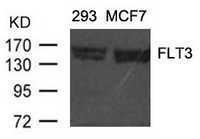
Western blot analysis of extracts from 293 and MCF cells using FLT3 Antibody .Application
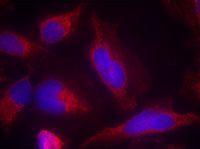
Immunofluorescence staining of methanol-fixed Hela cells using FLT3 Antibody .| Product Name | FLT3 antibody |
|---|---|
| Antibody Type | Primary Antibodies |
| Product description | Rabbit Polyclonal antibody to FLT3FLT3 encodes a class III receptor tyrosine kinase that regulates hematopoiesis. The receptor consists of an extracellular domain composed of five immunoglobulin-like domains, one transmembrane region, and a cytoplasmic kinase domain split into two parts by a kinase-insert domain. The receptor is activated by binding of the fms-related tyrosine kinase 3 ligand to the extracellular domain, which induces homodimer formation in the plasma membrane leading to autophosphorylation of the receptor. The activated receptor kinase subsequently phosphorylates and activates multiple cytoplasmic effector molecules in pathways involved in apoptosis, proliferation, and differentiation of hematopoietic cells in bone marrow. Mutations that result in the constitutive activation of this receptor result in acute myeloid leukemia and acute lymphoblastic leukemia. |
| Immunogen | Peptide sequence around aa.589~593 (Y-F-Y-V-D) derived from Human FLT3. |
| Clonality | Polyclonal |
|---|---|
| Host Species | Rabbit |
| Tested Applications | ICC/IFWB |
| Suggested starting dilutions are as follows. WB: 1:500~1:1000, ICC/IF: 1:100~1:200. Not yet tested in other applications. Optimal working dilutions should be determined experimentally by the end user.: |
|
| Species Reactivity | Human |
| Concentration | 1mg/ml (Please refer to the vial label for the specific concentration) |
| Purification | Affinity purified |
| Gene Synonyms | CD135 FLK2 STK1 FLT3 FLT3 receptor tyrosine kinase STK-1 FLT-3 CD135 antigen fetal liver kinase-2 stem cell tyrosine kinase 1 tyrosine-protein kinase receptor FLT3 growth factor receptor tyrosine kinase type III fms-like tyrosine kinase 3 FL c |
|---|---|
| Target | FLT3 |
| Molecular Weight(MW) | 130, 160 (note) |
Application
Western blot analysis of extracts from 293 and MCF cells using FLT3 Antibody .
Application
Immunofluorescence staining of methanol-fixed Hela cells using FLT3 Antibody .| Application Notes | Suggested starting dilutions are as follows. WB: 1:500~1:1000, ICC/IF: 1:100~1:200. Not yet tested in other applications. Optimal working dilutions should be determined experimentally by the end user.: |
|---|
| Form | Liquid |
|---|---|
| Storage Instructions | Keep as concentrated solution. Aliquot and store at -20ºC or below. Avoid multiple freeze-thaw cycles. |
| Storage Buffer | saline (without Mg2+ and Ca2+), pH 7.4, 150mM NaCl, 0.02% sodium azide and 50% glycerol. |


