Application
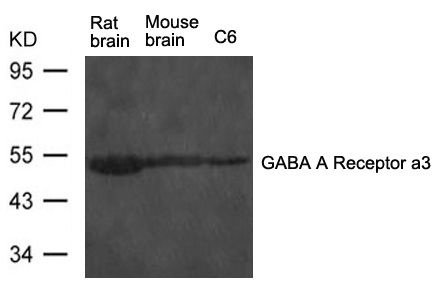
Western blot analysis of extract from rat brain and mouse brain tissue and C6 cells using GABA A Receptor a3 Antibody| Product Name | GABA A Receptor alpha 3 antibody |
|---|---|
| Antibody Type | Primary Antibodies |
| Product description | Rabbit Polyclonal antibody to GABA A Receptor a3GABA (gamma-aminobutyric acid) is the primary inhibitory neurotransmitter in the central nervous system and interacts with three different receptors: GABA(A), GABA(B) and GABA(C) receptor. The ionotropic GABA(A) and GABA(C) receptors are ligand-gated ion channels that produce fast inhibitory synaptic transmission. In contrast, the metabotropic GABA(B) receptor is coupled to G proteins that modulate slow inhibitory synaptic transmission (1). Functional GABA(B) receptors form heterodimers of GABA(B)R1 and GABA(B)R2 where GABA(B)R1 binds the ligand and GABA(B)R2 is the primary G protein contact site (2). Two isoforms of GABA(B)R1 have been cloned: GABA(B)R1a is a 130 kD protein and GABA(B)R1b is a 95 kD protein (3). G proteins subsequently inhibit adenyl cylase activity and modulate inositol phospholipid hydrolysis. GABA(B) receptors have both pre- and postsynaptic inhibitions: presynaptic GABA(B) receptors inhibit neurotransmitter release through suppression of high threshold calcium channels, while postsynaptic GABA(B) receptors inhibit through coupled activation of inwardly rectifying potassium channels. In addition to synaptic inhibition, GABA(B) receptors may also be involved in hippocampal long-term potentiation, slow wave sleep and muscle relaxation (1). |
| Immunogen | Peptide sequence around aa. 33~37(R-R-Q-E-P)derived from Rat GABA A Receptor a3. |
| Clonality | Polyclonal |
|---|---|
| Host Species | Rabbit |
| Tested Applications | WB |
| Suggested starting dilutions are as follows. WB: 1:500~1:1000. Not yet tested in other applications. Optimal working dilutions should be determined experimentally by the end user.: |
|
| Species Reactivity | HumanMouseRat |
| Concentration | 1mg/ml (Please refer to the vial label for the specific concentration) |
| Purification | Affinity purified |
| Gene Synonyms | Gamma-animobutyric acid (GABA) A receptor alpha 3 gamma-aminobutyric acid receptor subunit alpha-3 GABA(A) receptor subunit alpha-3 GABA-A receptor alpha-3 subunit gamma-aminobutyric acid receptor subunit alpha 3 Gamma-animobutyric acid (GABA) A rece |
|---|---|
| Target | GABA A Receptor a3 |
| Molecular Weight(MW) | 51 (note) |
Application
Western blot analysis of extract from rat brain and mouse brain tissue and C6 cells using GABA A Receptor a3 Antibody| Application Notes | Suggested starting dilutions are as follows. WB: 1:500~1:1000. Not yet tested in other applications. Optimal working dilutions should be determined experimentally by the end user.: |
|---|
| Form | Liquid |
|---|---|
| Storage Instructions | Keep as concentrated solution. Aliquot and store at -20ºC or below. Avoid multiple freeze-thaw cycles. |
| Storage Buffer | saline (without Mg2+ and Ca2+), pH 7.4, 150mM NaCl, 0.02% sodium azide and 50% glycerol. |


