Application
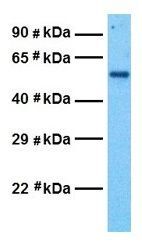
WB analysis of human fetal kidney tissue using GABA A Receptor delta antibody at 1μg/ml.| Product Name | GABA A Receptor delta antibody, N-term |
|---|---|
| Antibody Type | Primary Antibodies |
| Product description | Rabbit Polyclonal antibody to GABA A Receptor deltaGamma-aminobutyric acid (GABA) is the major inhibitory neurotransmitter in the mammalian brain where it acts at GABA-A receptors, which are ligand-gated chloride channels. Chloride conductance of these channels can be modulated by agents such as benzodiazepines that bind to the GABA-A receptor. The GABA-A receptor is generally pentameric and there are five types of subunits: alpha, beta, gamma, delta, and rho. This gene encodes the delta subunit. Mutations in this gene have been associated with susceptibility to generalized epilepsy with febrile seizures, type 5. Alternatively spliced transcript variants have been described for this gene, but their biological validity has not been determined. [provided by RefSeq, Jul 2008] |
| Immunogen | A synthetic peptide corresponding to a N-terminal region of Human GABA A Receptor delta |
| Clonality | Polyclonal |
|---|---|
| Isotype | IgG |
| Host Species | Rabbit |
| Tested Applications | WB |
| *Optimal dilutions/concentrations should be determined by the researcher.
: |
|
| Species Reactivity | Human |
| Predicted Reactivity | Cow: 100%; Dog: 100%; Human: 100%; Mouse: 100%; Rabbit: 100% |
| Concentration | 1mg/ml |
| Purification | Protein A |
| Gene Synonyms | GEFSP5 EJM7 GABRD EIG10 |
|---|---|
| Target | GABA A Receptor delta |
| Molecular Weight(MW) | 51 KDa (note) |
Application
WB analysis of human fetal kidney tissue using GABA A Receptor delta antibody at 1μg/ml.| Positive Control | human fetal kidney |
|---|---|
| Application Notes | *Optimal dilutions/concentrations should be determined by the researcher.
: |
| Form | Liquid |
|---|---|
| Storage Instructions | Keep as concentrated solution. For short-term storage, store at 4ºC. For long-term storage, aliquot and store at -20ºC or below. Avoid multiple freeze-thaw cycles. |
| Storage Buffer | 1x PBS buffer with 0.09% (w/v) sodium azide and 2% sucrose. |


