Application
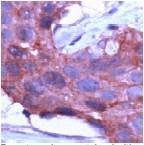
Breast carcinoma stained withApplication
Human Breast Carcinoma stained with anti-Catenin-gamma antibody| Product Name | gamma Catenin antibody |
|---|---|
| Antibody Type | Primary Antibodies |
| Product description | Rabbit polyclonal to gamma CateninGamma Catenin is a common junctional plaque protein. The membrane-associated plaques are architectural elements in an important strategic position to influence the arrangement and function of both the cytoskeleton and the cells within the tissue. The presence of gamma Catenin in both the desmosomes and in the intermediate junctions suggests that it plays a central role in the structure and function of submembranous plaques. |
| Immunogen | Synthetic peptide (Human) (C terminal). |
| Clonality | Polyclonal |
|---|---|
| Isotype | IgG |
| Host Species | Rabbit |
| Tested Applications | IHCIHC-PIPWB |
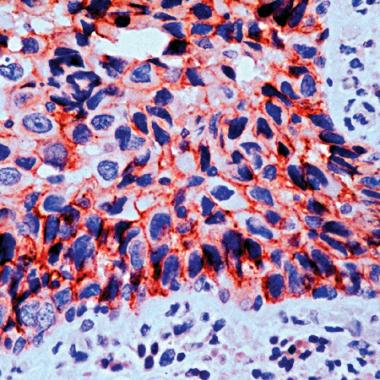
| IHC-P: Use at a dilution of 1/100 for 10 minutes at RT. Staining of formalin fixed tissues requires boiling tissue sections in 10mM citrate buffer, pH 6.0, for 10 mins followed by cooling at RT for 20 min. Ab 15153 stains gamma catenin on the cell membrane and in the cytoplasm of breast carcinoma. IP: Use at an assay dependent dilution. WB: Use at an assay dependent dilution. Predicted molecular weight: 82 kDa. Optimal dilutions/concentrations should be determined by the end user. | |
| Species Reactivity | HumanMouseRat |
| Concentration | 0.2mg/ml |
| Purification | Affinity purified |
| Gene Synonyms | PKGB, 3728, CTNNG, 173325, gamma Catenin, PDGB, DP3, DPIII, JUP, P14923 |
|---|---|
| Target | gamma Catenin |
| Cellular Localization | Cytoplasmic |
Application
Breast carcinoma stained with
Application
Human Breast Carcinoma stained with anti-Catenin-gamma antibody| Application Notes | IHC-P: Use at a dilution of 1/100 for 10 minutes at RT. Staining of formalin fixed tissues requires boiling tissue sections in 10mM citrate buffer, pH 6.0, for 10 mins followed by cooling at RT for 20 min. Ab 15153 stains gamma catenin on the cell membrane and in the cytoplasm of breast carcinoma. IP: Use at an assay dependent dilution. WB: Use at an assay dependent dilution. Predicted molecular weight: 82 kDa. Optimal dilutions/concentrations should be determined by the end user. |
|---|
| Form | Liquid |
|---|---|
| Storage Instructions | Keep as concentrated solution, aliquot and store at 4°C. Do not freeze. |
| Storage Buffer | Phosphate-buffered saline, pH 7.4 containing 1% BSA and 0.09% sodium azide |


