Application
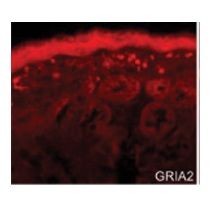
IHC-Fr analysis of mouse gut tissue using GRIA2 antibody at 20μg/ml.| Product Name | GluR2 antibody, N-term |
|---|---|
| Antibody Type | Primary Antibodies |
| Product description | Rabbit Polyclonal antibody to GluR2Glutamate receptors are the predominant excitatory neurotransmitter receptors in the mammalian brain and are activated in a variety of normal neurophysiologic processes. This gene product belongs to a family of glutamate receptors that are sensitive to alpha-amino-3-hydroxy-5-methyl-4-isoxazole propionate (AMPA), and function as ligand-activated cation channels. These channels are assembled from 4 related subunits, GRIA1-4. The subunit encoded by this gene (GRIA2) is subject to RNA editing (CAG->CGG; Q->R) within the second transmembrane domain, which is thought to render the channel impermeable to Ca(2+). Human and animal studies suggest that pre-mRNA editing is essential for brain function, and defective GRIA2 RNA editing at the Q/R site may be relevant to amyotrophic lateral sclerosis (ALS) etiology. Alternative splicing, resulting in transcript variants encoding different isoforms, (including the flip and flop isoforms that vary in their signal transduction properties), has been noted for this gene. [provided by RefSeq, Jul 2008] |
| Immunogen | A synthetic peptide corresponding to a N-terminal region of Human GluR2. |
| Clonality | Polyclonal |
|---|---|
| Isotype | IgG |
| Host Species | Rabbit |
| Tested Applications | IHC-F |
| *Optimal dilutions/concentrations should be determined by the researcher.
: |
|
| Species Reactivity | Mouse |
| Predicted Reactivity | Cow: 100%; Guinea Pig: 100%; Horse: 100%; Human: 100%; Mouse: 100%; Rabbit: 100%; Rat: 100%; Zebrafish: 92% |
| Concentration | 1mg/ml |
| Purification | Protein A |
| Gene Synonyms | GLUR K2 GRIA2 GLUA2 GLUR2 GLURB HBGR2 |
|---|---|
| Target | GluR2 |
| Molecular Weight(MW) | 99 KDa (note) |
Application
IHC-Fr analysis of mouse gut tissue using GRIA2 antibody at 20μg/ml.| Application Notes | *Optimal dilutions/concentrations should be determined by the researcher.
: |
|---|
| Form | Liquid |
|---|---|
| Storage Instructions | Keep as concentrated solution. For short-term storage, store at 4ºC. For long-term storage, aliquot and store at -20ºC or below. Avoid multiple freeze-thaw cycles. |
| Storage Buffer | 1x PBS buffer with 0.09% (w/v) sodium azide and 2% sucrose. |


