Application
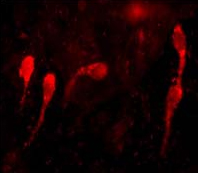
Immunlocalization of GnRH in mouse embryo forebrain using The tissue was incubated with for 3 nights.| Product Name | GnRH antibody |
|---|---|
| Antibody Type | Primary Antibodies |
| Product description | Rabbit Polyclonal antibody to GnRHGonadotropin releasing hormone (GnRH), also known as luteinizing hormone releasing hormone (LHRH), is a key molecule in the regulation of reproduction in vertebrates. GnRH, a decapeptide, is produced by neurons in the medial basal hypothalamus (MBH) and secreted in a pulsatile manner into the cardiovascular system. The frequency and amplitude of GnRH pulses determine secretion of follicle stimulating hormone (FSH) and luteinizing hormone (LH) from the pituitary. Higher frequencies (greater than one pulse per hour) stimulate LH secretion while lower frequencies stimulate FSH secretion. The generation of GnRH pulses is effected by numerous stimuli, such as neural, hormonal and environmental. Therefore, behavioral and physiological conditions such as sleep, exercise, and stress can affect the GnRH pulses and cause a disruption of the normal cycle. ? Recent studies show that GnRH also has a role in mediating cancer. GnRH has been shown to inhibit the growth of human uterine leiomyloma cells by suppressing proliferation and inducing apoptosis. GnRH analogs have been used to treat a wide variety of reproductive cancers, although the side effects of using such compounds are often quite severe. |
| Immunogen | Synthetic peptide corresponding to residues pyroE(22) H W S Y G L R P G-NH2(32) of mouse GnRH. |
| Clonality | Polyclonal |
|---|---|
| Host Species | Rabbit |
| Tested Applications | ICC/IFIHC |
| ICC/IF: 1:1,000: |
|
| Species Reactivity | MouseRat |
| Predicted Reactivity | RatRat(100%) |
| Concentration | 1mg/ml |
| Purification | Affinity purified |
| Gene Synonyms | 152760 GnRH 2796 LHRH LNRH P01148 GRH GNRH1 |
|---|---|
| Target | GnRH |
Application
Immunlocalization of GnRH in mouse embryo forebrain using The tissue was incubated with for 3 nights.| Application Notes | ICC/IF: 1:1,000: |
|---|
| Form | Liquid |
|---|---|
| Storage Instructions | Keep as concentrated solution. Aliquot and store at -20ºC or below. Avoid multiple freeze-thaw cycles. |
| Storage Buffer | PBS containing 0.05% sodium azide. |


