Application
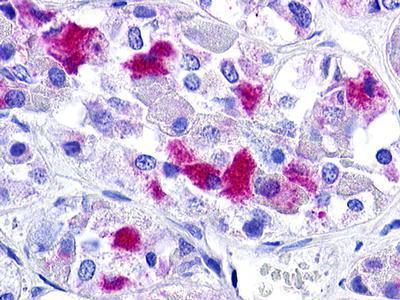
Immunohistochemical analysis of paraffin-embedded human pituitary tissue using anti-GnRHR antibody| Product Name | GnRHR antibody |
|---|---|
| Antibody Type | Primary Antibodies |
| Product description | Rabbit polyclonal to GnRHRGonadotropin-releasing hormone (GnRHR), a hypothalamic decapeptide, is a key neuroregulator of the reproductive process. It is synthesized by hypothalamic neurons, secreted in a pulsatile manner, and carried to the anterior lobe of the pituitary gland by way of the hypothalamohypophyseal portal circulation. The primary site of action of GnRHR in the pituitary gland is the gonadotrope, the cell that expresses GnRHR receptors and secretes gonadotropic hormones, which in turn regulate gametogenic and hormonal functions of the gonads. GnRHR receptor is a member of the G protein-coupled, Ca 2+ -dependent family of receptors. Located on the cell surface of pituitary gonadotropes, GnRHR transduces signals from GnRHR and modulates the synthesis and secretion of luteinizing hormone and follicle-stimulating hormone. GnRHR has been reported to be expressed mostly in the pituitary gonadotropes and in reproductive organs, including ovary, placenta, prostate, testis, and uterus. It is also expressed in breast, heart, kidney, liver, skeletal muscle, and thymus. |
| Immunogen | Synthetic peptide (unfortunately, the amino acid sequence is considered to be commercially sensitive) |
| Clonality | Polyclonal |
|---|---|
| Isotype | IgG |
| Host Species | Rabbit |
| Tested Applications | IHC-P |
| Optimal dilutions/concentrations should be determined by the end user.: |
|
| Species Reactivity | Human |
| Concentration | 1mg/ml (Please refer to the vial label for the specific concentration) |
| Purification | Affinity purified |
| Gene Synonyms | 138850 P30968 2798 GNRHR GRHR LRHR GNRHR1 LHRHR |
|---|---|
| Target | GnRHR |
| Cellular Localization | Cell Membrane |
Application
Immunohistochemical analysis of paraffin-embedded human pituitary tissue using anti-GnRHR antibody| Application Notes | Optimal dilutions/concentrations should be determined by the end user.: |
|---|
| Form | Liquid |
|---|---|
| Storage Instructions | Keep as concentrated solution. Store at 4ºC short term. For extended storage aliquot and store at -20ºC or below. Avoid freeze-thaw cycles. |
| Storage Buffer | Preservative: 0.01% Sodium Azide; Constituents: PBS. pH 7.4 |


