Application
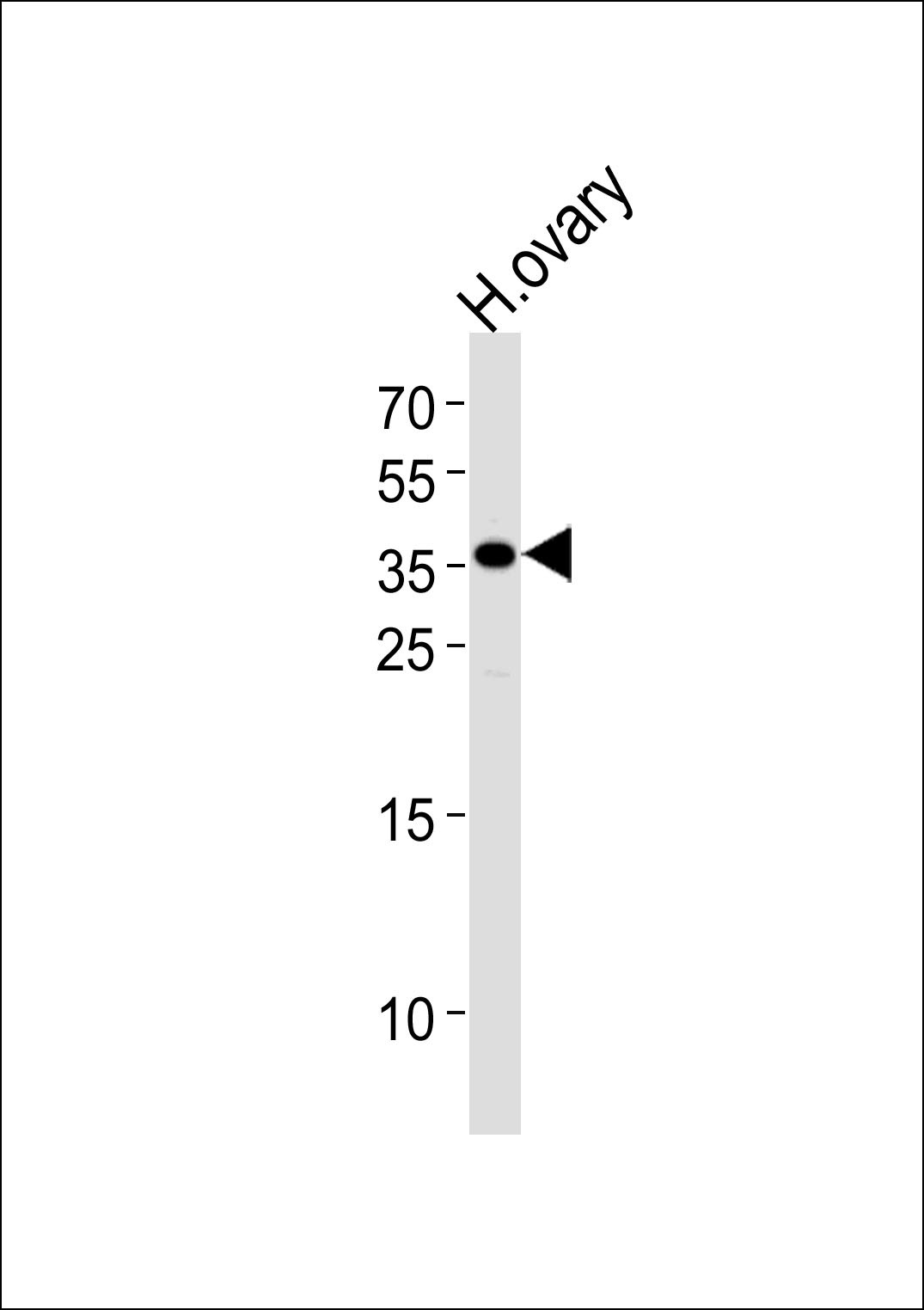
Western blot analysis of lysate from human ovary tissue lysate, using GNRHR Antibody at 1:1000 at each lane.| Product Name | GNRHR Antibody |
|---|---|
| Antibody Type | Primary Antibodies |
| Antigen Alias | Gonadotropin-releasing hormone receptor, GnRH receptor, GnRH-R, GNRHR, GRHR |
| Product description | This gene encodes the receptor for type 1 gonadotropin-releasing hormone. This receptor is a member of the seven-transmembrane, G-protein coupled receptor (GPCR) family. It is expressed on the surface of pituitary gonadotrope cells as well as lymphocytes, breast, ovary, and prostate. Following binding of gonadotropin-releasing hormone, the receptor associates with G-proteins that activate a phosphatidylinositol-calcium second messenger system. Activation of the receptor ultimately causes the release of gonadotropic luteinizing hormone (LH) and follicle stimulating hormone (FSH). Defects in this gene are a cause of hypogonadotropic hypogonadism (HH). Alternative splicing results in multiple transcript variants encoding different isoforms. More than 18 transcription initiation sites in the 5' region and multiple polyA signals in the 3' region have been identified for this gene.1) Canzian, F., et al. Hum. Mol. Genet. 19(19):3873-3884(2010) |
| Immunogen | This GNRHR antibody is generated from rabbits immunized with a KLH conjugated synthetic peptide between 49-77 amino acids from the N-terminal region of human GNRHR. |
| Clonality | Polyclonal |
|---|---|
| Isotype | Ig |
| Host Species | Rabbit |
| Tested Applications | WB |
| For WB starting dilution is: 1:1000: |
|
| Species Reactivity | Human |
| Concentration | 1mg/ml |
| Purification | Affinity purified |
| Gene Symbol | GNRHR |
|---|---|
| Alternative Names | Gonadotropin-releasing hormone receptor GnRH receptor GnRH-R GNRHR GRHR |
| Molecular Weight(MW) | 38 kDa |
Application
Western blot analysis of lysate from human ovary tissue lysate, using GNRHR Antibody at 1:1000 at each lane.| Application Notes | For WB starting dilution is: 1:1000: |
|---|
| Form | Liquid |
|---|---|
| Storage Instructions | Store at 4˚C for three months and -20˚C, stable for up to one year. As with all antibodies care should be taken to avoid repeated freeze thaw cycles. Antibodies should not be exposed to prolonged high temperatures. |
| Storage Buffer | Supplied in PBS with 0.09% (W/V) sodium azide. |


