Application
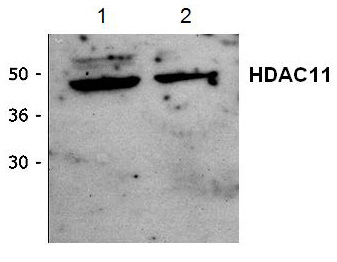
Western blot analysis of HDAC11 in lysates from Jurkat cells (Lane 1) and mouse small intestine (Lane 2).Application
Application| Product Name | HDAC11 antibody |
|---|---|
| Antibody Type | Primary Antibodies |
| Product description | Rabbit polyclonal to HDAC11Histone deacetylase (HDAC) and histone acetyltransferase (HAT) are enzymes that regulate transcription by selectively deacetylating or acetylating the eta-amino groups of lysines located near the amino termini of core histone proteins. Eight members of HDAC family have been identified in the past several years. These HDAC family members are divided into two classes, I and II. Class I of the HDAC family comprises four members, HDAC-1, 2, 3, and 8, each of which contains a deacetylase domain exhibiting from 45 to 93% identity in amino acid sequence. Class II of the HDAC family comprises HDAC-4, 5, 6, and 7, the molecular weights of which are all about twofold larger than those of the class I members, and the deacetylase domains are present within the C-terminal regions, except that HDAC-6 contains two copies of the domain, one within each of the N-terminal and C-terminal regions. Human HDAC-1, 2 and 3 were expressed in various tissues, but the others (HDAC-4, 5, 6, and 7) showed tissue-specific expression patterns. Recently, a new member of this family, HDAC11, has been cloned. HDAC11 transcripts is limited to kidney, heart, brain, skeletal muscle, and testis. These results suggested that each member of the HDAC family exhibits a different, individual substrate specificity and function in vivo. |
| Immunogen | Synthetic peptide, corresponding to amino acids surrounding 269 of Human HDAC 11 |
| Clonality | Polyclonal |
|---|---|
| Isotype | IgG |
| Host Species | Rabbit |
| Tested Applications | IHCWB |
| Recommended dilutions:WB: Use at a concentration of 1 - 4 μg/ml. Predicted molecular weight: 39 kDa. Not yet tested in other applications.Optimal dilutions/concentrations should be determined by the end user. | |
| Species Reactivity | HumanMouseRat |
| Concentration | 0.2mg/ml |
| Purification | Affinity purified |
| Gene Synonyms | FLJ22237, HD11 |
|---|---|
| Target | HDAC11 |
| Tissue Specificity | recognises 39 kDa HDAC-11 of human and mouse origin. It alsoreacts with rat weakly. |
| Cellular Localization | Nuclear |
Application
Western blot analysis of HDAC11 in lysates from Jurkat cells (Lane 1) and mouse small intestine (Lane 2).
Application
Application| Positive Control | Jurkat cell lysate, Mouse intestine tissue lysate |
|---|---|
| Application Notes | Recommended dilutions:WB: Use at a concentration of 1 - 4 μg/ml. Predicted molecular weight: 39 kDa. Not yet tested in other applications.Optimal dilutions/concentrations should be determined by the end user. |
| Form | Liquid |
|---|---|
| Storage Instructions | Aliquot and store at -20°C or -80°C. Avoid repeated freeze / thaw cycles. |
| Storage Buffer | Preservative: 0.02% Thimerosal (merthiolate) Constituents: 50% Glycerol, 1% BSA, PBS |


