Application
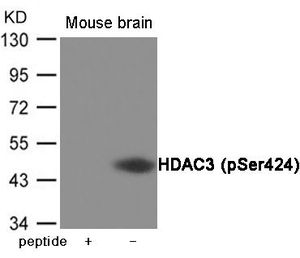
Western blot analysis of extracts from Mouse brain tissue using HDAC3 (Phospho-Ser424) Antibody. The lane on the left is treated with the antigen-specific peptide.| Product Name | HDAC3 (phospho Ser424) antibody |
|---|---|
| Antibody Type | Primary Antibodies |
| Product description | Rabbit Polyclonal antibody to HDAC3 (phospho Ser424)Histones play a critical role in transcriptional regulation, cell cycle progression, and developmental events. Histone acetylation/deacetylation alters chromosome structure and affects transcription factor access to DNA. The protein encoded by this gene belongs to the histone deacetylase/acuc/apha family. It has histone deacetylase activity and represses transcription when tethered to a promoter. It may participate in the regulation of transcription through its binding with the zinc-finger transcription factor YY1. This protein can also down-regulate p53 function and thus modulate cell growth and apoptosis. This gene is regarded as a potential tumor suppressor gene. [provided by RefSeq, Jul 2008] |
| Immunogen | Peptide sequence around phosphorylation site of Serine 424 (K-E-S(p)-D-V) derived from Human HDAC3 |
| Modification | p-Ser424 |
| Clonality | Polyclonal |
|---|---|
| Isotype | IgG |
| Host Species | Rabbit |
| Tested Applications | WB |
| WB: 1:500 - 1:1000 | |
| Species Reactivity | HumanMouseRat |
| Concentration | 1mg/ml (Please refer to the vial label for the specific concentration) |
| Purification | Affinity purified |
| Gene Synonyms | RPD3-2 , RPD3 , HD3 , histone deacetylase 3 , HDAC3 |
|---|---|
| Target | HDAC3 (phospho Ser424) |
| Tissue Specificity | The antibody detects endogenous level of HDAC3 only when phosphorylated at Serine 424. |
Application
Western blot analysis of extracts from Mouse brain tissue using HDAC3 (Phospho-Ser424) Antibody. The lane on the left is treated with the antigen-specific peptide.| Application Notes | WB: 1:500 - 1:1000 |
|---|
| Form | Liquid |
|---|---|
| Storage Instructions | Store at -20˚C/1 year |
| Storage Buffer | Supplied at 1.0mg/mL in phosphate buffered saline (without Mg2+ and Ca2+), pH 7.4, 150mM NaCl, 0.02% sodium azide and 50% glycerol. |


