Application
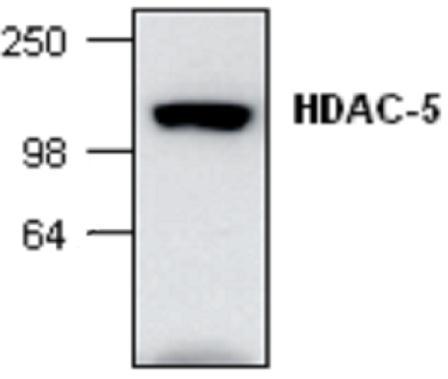
Western blot analysis of HDAC5 expression in Jurkat cell lysate.| Product Name | HDAC5 antibody |
|---|---|
| Antibody Type | Primary Antibodies |
| Product description | Rabbit polyclonal antibody to HDAC5Human HDAC5 is composed of 1122 amino acid residues. The deacetylase domain of HDAC5 is located at the C-terminal half of the molecule. The N-terminal non-deacetylase domain does not show any significant homology with any published sequence. Both domains are required for HDAC5-mediated repression of gene transcription. HDAC5 interacts with a growing number of transcriptional factors including MEF2A as well as other HDAC proteins. The interacting complexes bind to specific regions of chromatin and regulate gene transcription in these regions. |
| Clonality | Polyclonal |
|---|---|
| Isotype | IgG |
| Host Species | Rabbit |
| Tested Applications | IHCIPWB |
| Western blotting (0.5-4 µg/ml), Immunoprecipitation (20 µg/ml), and Immunohistochemistry (20 µg/ml). However, the optimal conditions should be determined individually. The antibody detects ~124 kDa HDAC5 with human and mouse samples, and in a lesser extent with rat samples. It does not cross-react with other HDAC proteins including HDAC1, 2, 3, 4, 6, 7, 8, 9,10, and 11. | |
| Species Reactivity | HumanMouseRat |
| Concentration | 0.5mg/ml |
| Purification | Affinity purified |
| Gene Synonyms | FLJ90614, HD5, NYCO9, KIAA0600, NY-CO-9, HDAC5, NY CO 9 |
|---|---|
| Target | HDAC5 |
| Tissue Specificity | This antibody is specific for HDAC5. |
| Cellular Localization | Shuttles between the nucleus and the cytoplasm. In muscle cells, it shuttles into the cytoplasm during myocyte differentiation. The export to cytoplasm depends on the interaction with a 14-3-3 chaperone protein and is due to its phosphorylation at Ser-259 |
Application
Western blot analysis of HDAC5 expression in Jurkat cell lysate.| Application Notes | Western blotting (0.5-4 µg/ml), Immunoprecipitation (20 µg/ml), and Immunohistochemistry (20 µg/ml). However, the optimal conditions should be determined individually. The antibody detects ~124 kDa HDAC5 with human and mouse samples, and in a lesser extent with rat samples. It does not cross-react with other HDAC proteins including HDAC1, 2, 3, 4, 6, 7, 8, 9,10, and 11. |
|---|
| Form | Liquid |
|---|---|
| Storage Instructions | The antibody solution should be gently mixed before use. Stored at -20 °C for future use. |
| Storage Buffer | PBS (pH 7.2) containing 30% glycerol, 0.5% BSA, 0.01% thimerosal |


