Application
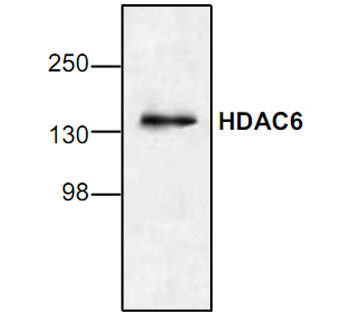
Western blot analysis of HDAC6 using in Jurkat cell lysateApplication
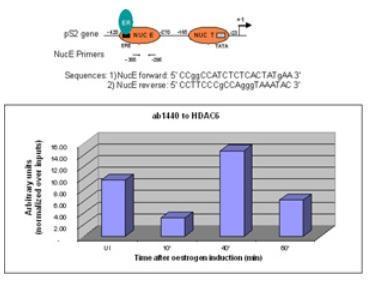
Sonicated Chromatin prepared from untreated (UI) or 17beta-estradiol (E2) treated MCF7 cells was subjected to the ChIP procedure with to HDAC6 and the immunoprecipitated chromatin was analysed in the proximal region of the estrogen-responsive pS2 promoter (as shown above) and quantified by real-time PCR (values are nomalized over inputs). The primers are designed to follow the nucleosome E (including the Estrogen Responsive Element ERE). 10 ul of and 2x10*6 cells were used in each ChIP experiment| Product Name | HDAC6 antibody |
|---|---|
| Antibody Type | Primary Antibodies |
| Product description | Rabbit polyclonal to HDAC6 - ChIP GradeHDAC6 is a member of the class II mammalian histone deacetylases. Human HDAC6 is composed of 1215 amino acid residues. It possesses two separate putative catalytic domains. Both catalytic domains are fully functional HDACs and contribute independently to the overall activity of HDAC6 protein. A very potent NES is present at the amino-terminus of HDAC6, which was found to play an important role in regulating the shuttling of HDAC6 protein between cytoplasm and nucleus. The shuttling process may be a critical regulatory mechanism of HDAC6 function. The expression of HDAC6 is tightly linked to the state of cell differentiation. HDAC6 may participate in coordinating expression of a group of genes involved in the remodeling of chromatin during cell differentiation. |
| Clonality | Polyclonal |
|---|---|
| Isotype | IgG |
| Host Species | Rabbit |
| Tested Applications | IHC-PWBChIP |
| ChIP: Use 10μl for 10^6 cells. IHC-P: Use at an assay dependent dilution. WB: Use at a concentration of 1 μg/ml. Predicted molecular weight: 131 kDa (MW can be higher as the protein can be post-translationally modified (ubiquitinated, sumoylated)) . Optimal dilutions/concentrations should be determined by the end user. | |
| Species Reactivity | HumanMouseRat |
| Concentration | 0.2mg/ml |
| Purification | Affinity purified |
| Gene Synonyms | HDAC6, 10013, 300272, Q9UBN7, JM21, HD6, Hdac5, Sfc6, mHDA2 |
|---|---|
| Target | HDAC6 |
| Tissue Specificity | The antibody detects ~134 kDa histone deacetylase 6. It does not cross-react with other HDAC proteins including HDAC1, 2, 3, 4, 5, 7, and 8. |
| Cellular Localization | Cytoplasmic and Nuclear |
Application
Western blot analysis of HDAC6 using in Jurkat cell lysate
Application
Sonicated Chromatin prepared from untreated (UI) or 17beta-estradiol (E2) treated MCF7 cells was subjected to the ChIP procedure with to HDAC6 and the immunoprecipitated chromatin was analysed in the proximal region of the estrogen-responsive pS2 promoter (as shown above) and quantified by real-time PCR (values are nomalized over inputs). The primers are designed to follow the nucleosome E (including the Estrogen Responsive Element ERE). 10 ul of and 2x10*6 cells were used in each ChIP experiment| Application Notes | ChIP: Use 10μl for 10^6 cells. IHC-P: Use at an assay dependent dilution. WB: Use at a concentration of 1 μg/ml. Predicted molecular weight: 131 kDa (MW can be higher as the protein can be post-translationally modified (ubiquitinated, sumoylated)) . Optimal dilutions/concentrations should be determined by the end user. |
|---|
| Form | Liquid |
|---|---|
| Storage Instructions | Keep as concentrated solution. Store at 4ºC short term. For extended storage aliquot and store at -20ºC or below. Avoid freeze-thaw cycles. |
| Storage Buffer | PBS pH7.2 with 50% glycerol, 1% BSA and 0.02% sodium azide |


