Application
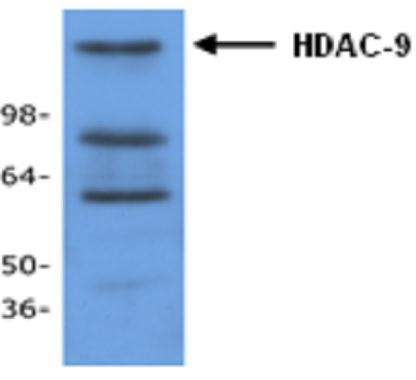
Western blot analysis of HDAC-9 in mouse small intestine tissue lysate.| Product Name | HDAC9 antibody |
|---|---|
| Antibody Type | Primary Antibodies |
| Product description | Rabbit polyclonal antibody to HDAC9HDAC family members have been divided into two classes. Class I of the HDACs comprises four members, HDAC-1, 2, 3, and 8, each of which contains a deacetylase domain exhibiting from 45 to 93% identity in amino acid sequence. Class II of the HDACs comprises HDAC-4, 5, 6, and 7, the molecular weights of which are all about two-fold larger than those of the class I members, and the deacetylase domains are present within the C-terminal regions, except that HDAC-6 contains two copies of the domain, one within each of the N-terminal and C-terminal regions. Human HDAC-1, 2 and 3 were expressed in various tissues, but the others (HDAC-4, 5, 6, and 7) showed tissue-specific expression patterns. |
| Clonality | Polyclonal |
|---|---|
| Isotype | IgG |
| Host Species | Rabbit |
| Tested Applications | WB |
| Western blotting (0.5-4 µg/ml), Immunoprecipitation and immunofluorescence. However, the optimal concentrations should be determined individually. The antibody recognizes a ~110-140 kDa of HDAC-9. A 75 kDa and a 60 kDa bands can also be detected in some tissue lysates.: |
|
| Species Reactivity | HumanMouseRat |
| Concentration | 0.2mg/ml |
| Purification | Affinity purified |
| Gene Synonyms | Histone deacetylase9 Histone deacetylase 9 HDAC9 HD9 |
|---|---|
| Target | HDAC9 |
| Tissue Specificity | This antibody is specific for HDAC9. |
Application
Western blot analysis of HDAC-9 in mouse small intestine tissue lysate.| Application Notes | Western blotting (0.5-4 µg/ml), Immunoprecipitation and immunofluorescence. However, the optimal concentrations should be determined individually. The antibody recognizes a ~110-140 kDa of HDAC-9. A 75 kDa and a 60 kDa bands can also be detected in some tissue lysates.: |
|---|
| Form | Liquid |
|---|---|
| Storage Instructions | The antibody solution should be gently mixed before use. Stored at -20 °C for future use. |
| Storage Buffer | PBS (pH 7.2) containing 30% glycerol, 0.5% BSA, and 0.01% thimerosal |


