Application
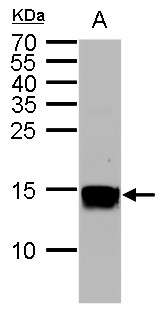
Histone H3 (di-Methyl Lys36) antibody [GT1488] detects Histone H3 (di-Methyl Lys36) protein by western blot analysis. A. 30 μg HeLa whole cell lysate/extract 15 % SDS-PAGE Histone H3 (di-Methyl Lys36) antibody [GT1488] dilution: 1:1000| Product Name | Histone H3K36me2 (dimethyl Lys36) antibody |
|---|---|
| Antibody Type | Primary Antibodies |
| Product description | Mouse Monoclonal antibody [GT1488] to Histone H3 (di-Methyl Lys36) (histone cluster 1, H3a)Histones are basic nuclear proteins that are responsible for the nucleosome structure of the chromosomal fiber in eukaryotes. This structure consists of approximately 146 bp of DNA wrapped around a nucleosome, an octamer composed of pairs of each of the four core histones (H2A, H2B, H3, and H4). The chromatin fiber is further compacted through the interaction of a linker histone, H1, with the DNA between the nucleosomes to form higher order chromatin structures. This gene is intronless and encodes a member of the histone H3 family. Transcripts from this gene lack polyA tails; instead, they contain a palindromic termination element. This gene is found in the large histone gene cluster on chromosome 6p22-p21.3. [provided by RefSeq] |
| Modification | dimethyl Lys36 |
| Clonality | Monoclonal |
|---|---|
| Isotype | IgG3 |
| Clone Number | GT1488 |
| Host Species | Mouse |
| Tested Applications | WB |
| *Optimal dilutions/concentrations should be determined by the researcher.
: |
|
| Species Reactivity | HumanDrosophila |
| Predicted Reactivity | MouseMouse (100%) |
| Concentration | 1mg/ml (Please refer to the vial label for the specific concentration) |
| Purification | Affinity purified |
| Gene Synonyms | Histone H3 di Methyl di Methyl Histone H3 histone cluster 1 H3a H3/A HIST1H3A Histone H3 di-Methyl di-Methyl Lys36 Histone H3 Histone H3 di-Methyl K36 H3FA di Methy |
|---|---|
| Target | Histone H3 (di-Methyl Lys36) |
| Molecular Weight(MW) | 15 kDa (note) |
| Cellular Localization | Nucleus |
Application
Histone H3 (di-Methyl Lys36) antibody [GT1488] detects Histone H3 (di-Methyl Lys36) protein by western blot analysis. A. 30 μg HeLa whole cell lysate/extract 15 % SDS-PAGE Histone H3 (di-Methyl Lys36) antibody [GT1488] dilution: 1:1000| Positive Control | HeLa , *S2 |
|---|---|
| Application Notes | *Optimal dilutions/concentrations should be determined by the researcher.
: |
| Form | Liquid |
|---|---|
| Storage Instructions | Keep as concentrated solution. Aliquot and store at -20ºC or below. Avoid multiple freeze-thaw cycles. |
| Storage Buffer | PBS |


