Application
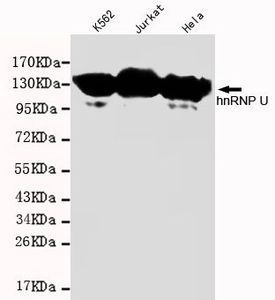
WB analysis of K562, Jurkat and HeLa lysates using hnRNP U antibody at a dilution of 1:1,000.| Product Name | hnRNP U antibody |
|---|---|
| Antibody Type | Primary Antibodies |
| Product description | Mouse Monoclonal antibody [1B11-H2-B7] to hnRNP UThis gene belongs to the subfamily of ubiquitously expressed heterogeneous nuclear ribonucleoproteins (hnRNPs). The hnRNPs are RNA binding proteins and they form complexes with heterogeneous nuclear RNA (hnRNA). These proteins are associated with pre-mRNAs in the nucleus and appear to influence pre-mRNA processing and other aspects of mRNA metabolism and transport. While all of the hnRNPs are present in the nucleus, some seem to shuttle between the nucleus and the cytoplasm. The hnRNP proteins have distinct nucleic acid binding properties. The protein encoded by this gene contains a RNA binding domain and scaffold-associated region (SAR)-specific bipartite DNA-binding domain. This protein is also thought to be involved in the packaging of hnRNA into large ribonucleoprotein complexes. During apoptosis, this protein is cleaved in a caspase-dependent way. Cleavage occurs at the SALD site, resulting in a loss of DNA-binding activity and a concomitant detachment of this protein from nuclear structural sites. But this cleavage does not affect the function of the encoded protein in RNA metabolism. At least two alternatively spliced transcript variants have been identified for this gene. [provided by RefSeq, Jul 2008] |
| Immunogen | Purified recombinant human HNRNPU protein fragments expressed in E.coli. |
| Clonality | Monoclonal |
|---|---|
| Isotype | IgG1 |
| Clone Number | 1B11-H2-B7 |
| Host Species | Mouse |
| Tested Applications | WB |
| WB:1:500~1:2000 Notes:Optimal dilutions/concentrations should be determined by the researcher. |
|
| Species Reactivity | Human |
| Concentration | 1mg/ml |
| Purification | Affinity purified |
| Gene Synonyms | SAF-A U21.1 HNRPU HNRNPU heterogeneous nuclear ribonucleoprotein U (scaffold attachment factor A) |
|---|---|
| Target | hnRNP U |
| Molecular Weight(MW) | 110kDa (note) |
| Cellular Localization | Nucleus. Cytoplasm. Cell surface. |
Application
WB analysis of K562, Jurkat and HeLa lysates using hnRNP U antibody at a dilution of 1:1,000.| Application Notes | WB:1:500~1:2000 Notes:Optimal dilutions/concentrations should be determined by the researcher. |
|---|
| Form | Liquid |
|---|---|
| Storage Instructions | Keep as concentrated solution. Aliquot and store at -20ºC or below. Avoid multiple freeze-thaw cycles. |
| Storage Buffer | Purified mouse monoclonal in buffer containing 0.1M Tris-Glycine (pH 7.4, 150 mM NaCl) with 0.02% sodium azide, 50% glycerol |


